-
March 6
It is Wednesday of the first week of March of the hottest winter on record, it is raining, so it feels like a perfectly adequate time to freak out, which I am doing right now. I feel myself in this strange liminal space, like Lewis’ forest between the worlds, except that there is nothing peaceful or calm about it. I am torn between the compassion and anger about the suffering of Palestinians that is so disproportionate and cruel it almost seems unreal. Who would do that? Who would think of that? On the other hand, I feel growing discomfort. Every social media post I read about how morally corrupt and despicable all the western governments are, how “the western powers” are war criminals, every post that uses monikers like “bloody-this” and “genocide-that” makes me cringe. not that I disagree, it’s just the feeling of discomfort that I can’t shrug off. This morning it dawned on me: the reason I feel this uncomfortable is because these posts of rightful outrage are becoming word-by-word copies of the Soviet propaganda I heard as a child. Corrupt West, colonialist Europe, bloody governments, all the while ignoring the Uyghur genocide, the multitude of Russian crimes and so many other things. It is chillingly familiar: give the world one war, one crime, one atrocity to focus on and forget all the rest. Draw the lines, deepen the divide, turn truth and compassion into propaganda. You can build an Iron curtain with that material, a three-meter concrete wall, literally overnight. Better still, make them turn against each other while you carry on solidifying the east against west, south against north, while you profit off selling weapons and oil and gold. We all have ancestral memory and mine, the DNA of my ancestors, starved, executed, deported and cut off their culture, finally wakes up to recognise the rallying KGB cry. And I am very very scared. Understand, it is not about who is wrong or right, it is about the division to the point of no return. Now, the real monsters will come.
-
March 5
Sometimes
I forget to finish a thought
Sometimes
Someone else decides to do it for me
Which is something
I am sometimes
Grateful for
Unless it is done
In a rude and mansplaining way
Sometimes
I stop mid sentence
Sometimes
My brain decides to remember
That the language I speak
Is not my own
And every word
Starts sounding funny
and unfamiliar
Sometimes
I become afraid
When I realise that I forgot the names
Of the streets
In my home town
Sometimes
I panic
How will I come back
How will I find myself
In the labyrinth of memory
I wasn’t planning
To write about immigration
The initial plan was to write that
Sometimes
I send you unfinished texts
Trusting
That you know the end
I struggle to articulate
An alternative ending:
Sometimes
I wish I could call myself
A poet, an activist, a matriarch
Whatever that means
A leader
Without blushing
Or thinking myself a fraud
Or toning it down
I wish I could own the thoughts in my head
Say them out loud
Finish my sentences
With a loud
Listen to me
-
March 4
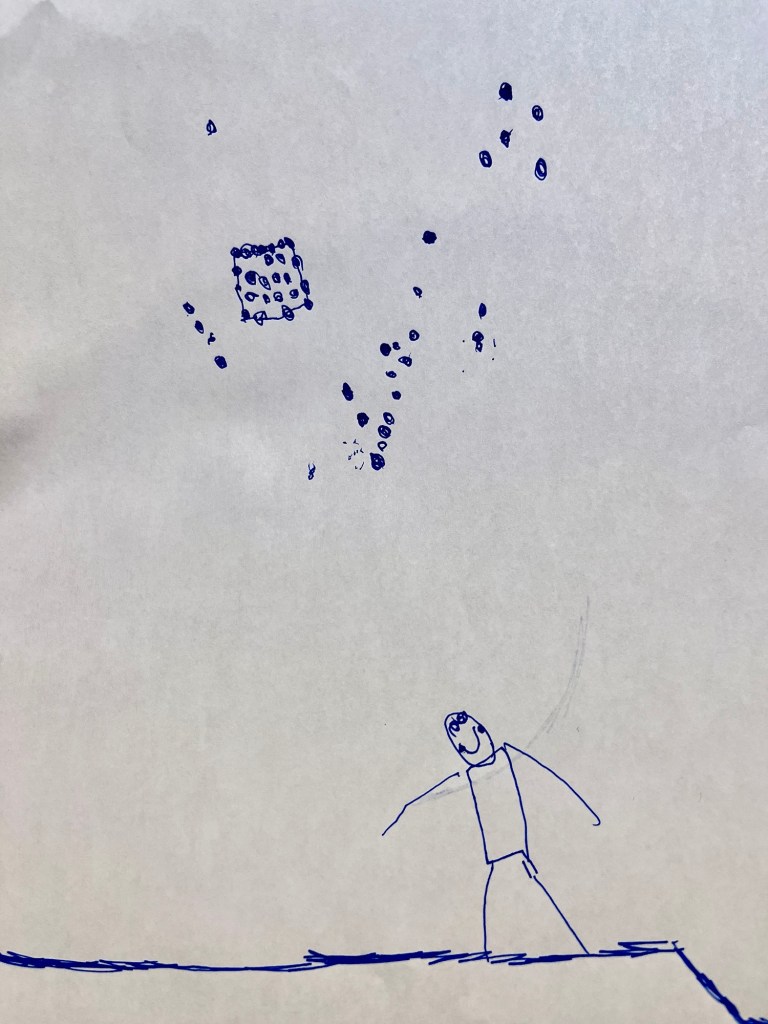
“L’humain et les étoiles” by Julien, 5 years old We walked back home in the dusk today and counted stars, but the moon was nowhere to be found and it felt terribly important. There was no moon in the sky tonight, March 4.
Karel wrote today that the end of winters will also mean the end of our culture, well, their culture. I know that what is happening on this warm and balmy day may be the beginning of an end, but for a moment it just feels like a beginning, an emergence of something. It feels like spring. It is in a wrong time and place. It is lost, poor darling, but insistent: the sap is running, the topsoil feels wet and ready, like a womb about to give birth. I may need to check on the crocuses and planting the milkweed seeds I’ve been keeping since last spring.
I had so many thoughts today. About Kamala Harriss’ call for ceasefire, about Navalny and the reason I think everyone should read Kostyuchenko’s book about Russia. But I realized that I don’t want to write down any of them. Presuming that I will have a chance to read this many years from now, I want to remember the untimely spring and the moonless night, the heartbreak, the love, but not the politics.
-
March 3
It was supposed to be the dead of the winter. Well, maybe not the dead of it, but the time when sunny days follow vicious blizzards. It took me long enough to get used to the idea that March is a winter month. Now, I don’t know what to think anymore.
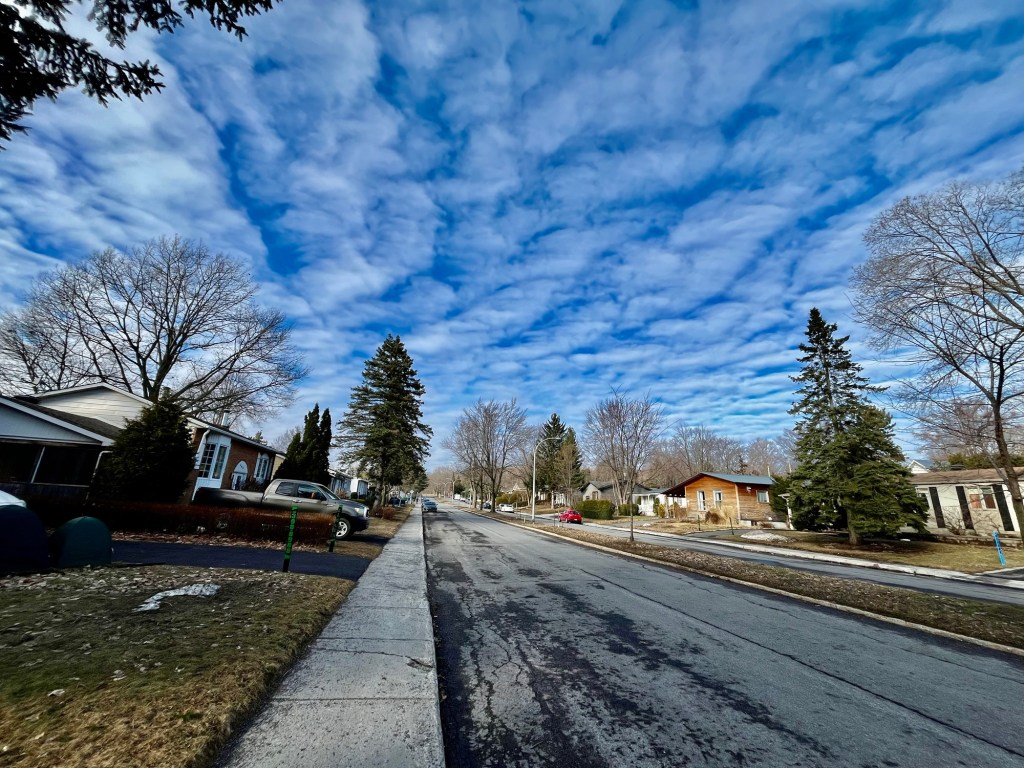
Clearview boulevard stretches in an almost straight line from the entrance to the city to the edge of the forest. The edge of the forest is a large clearing with very old apple trees that no one tends to anymore. In the late summer, does come here to feast on apples. Some evenings there are as many as a dozen. They lift their heads and watch me, the intruder, with wary eyes. Sometimes they let me pass without a movement. Sometimes I step on a stick of make a brusque movement and they take off into the forest.
I think that the Clearview boulevard is the best street in the world, because it leads to the forest. It is a busy street, probably the busiest in our town. It proudly hosts our town’s tiny concert hall, a gas station, a half a dozen bus stops, a Tim Horton’s, a local shopping centre, an ice arena, a high school of incredible ugliness and right behind a private condo complex – the closest thing our town has to a gated community. The condos boast a view of sunsets over a water reservoir) to which they have an exclusive access. I tend to think of them as class enemies, but I still love their view.
Past the condo complex the street becomes quaint and quiet. One can be almost sure that everyone walking either goes to the forest, or comes from it. Then, without warning, the town ends and the forest begins.
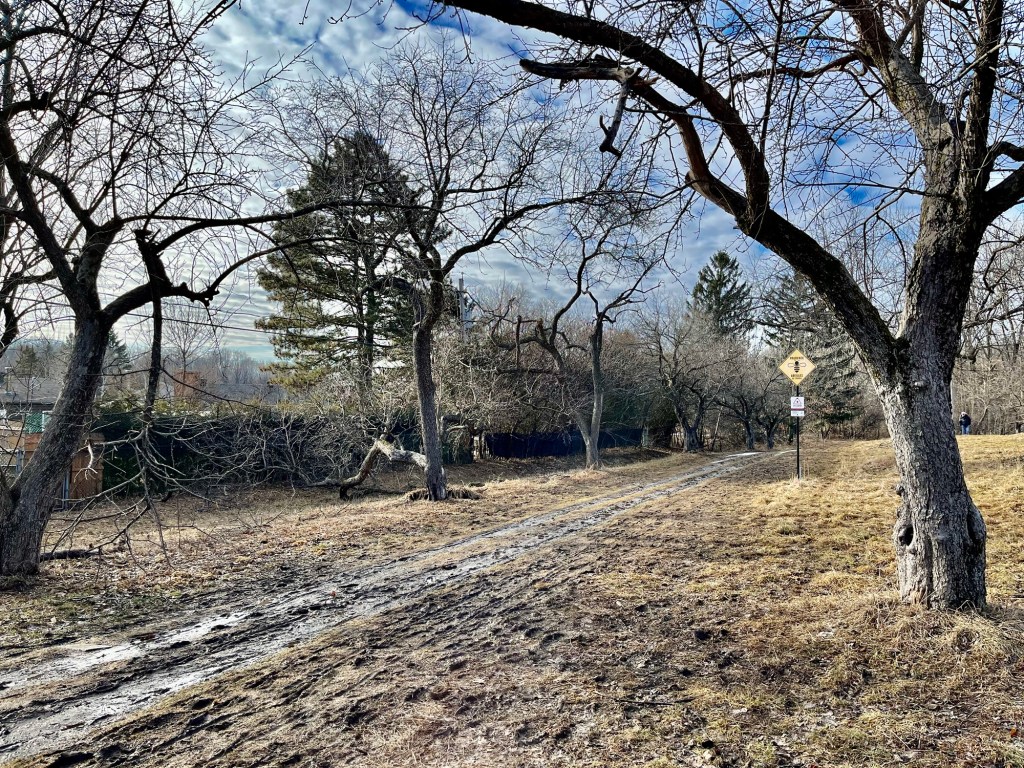
I almost gave up on my walk, except I couldn’t. The melting of snow, at least a month too early, and recent rains made the paths almost impracticable.
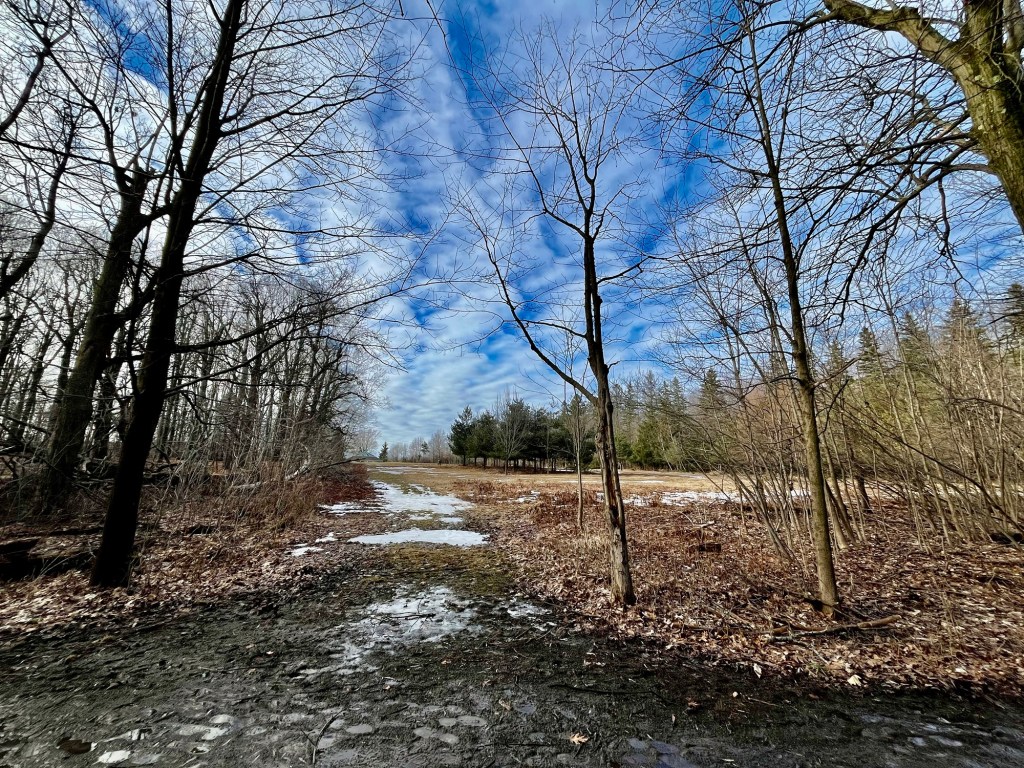
The mud slowed down my pace and transformed my walk into something unexpected. It was almost like interacting with another form of life: the mud was slick and slippery in some places, sticky and gooey in others. It yielded under my weight and made me yield in return, as I slowed down, looking for footing. In some places, it was possible to walk on the leaves carpet along the path – it felt like stepping on a trampoline.
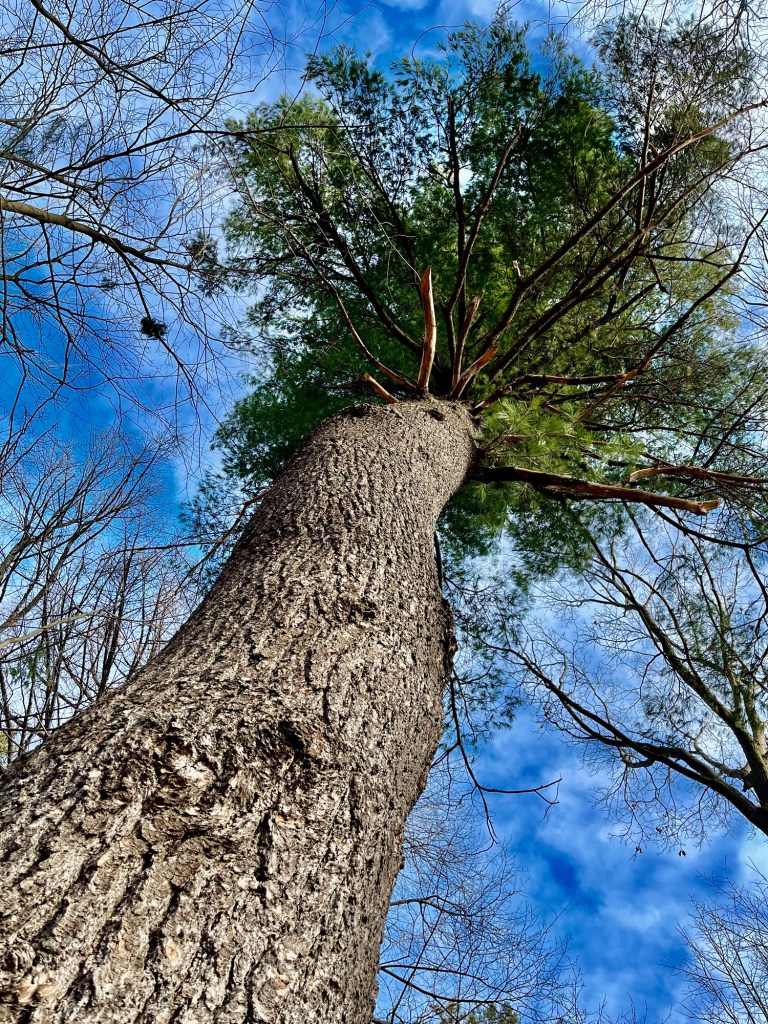
I often choose to walk in the arboreum, because there is hardly ever anyone else there. I try to memorize the names of the trees and tell them apart – it doesn’t come easy to me, especially when the trees are naked. There is Elm, Butternut Hickory, Black and Sugar Maple, Black Cherry, Red Cedar and White Eastern Cedar. Then there is this White Pine that looks like arboreum’s matriarch to me.
I my native language, forest is masculine and tree is neutral (neither masculine nor feminine), so I grew up thinking of forests in masculine terms. Recently, I realized that metaphorically (if not biologically), the trees are much closer to the feminine. Thus transformed my view of the forest. Now I see the community of mothers, aunts and grandmothers. Now I feel safe and confident in their company.
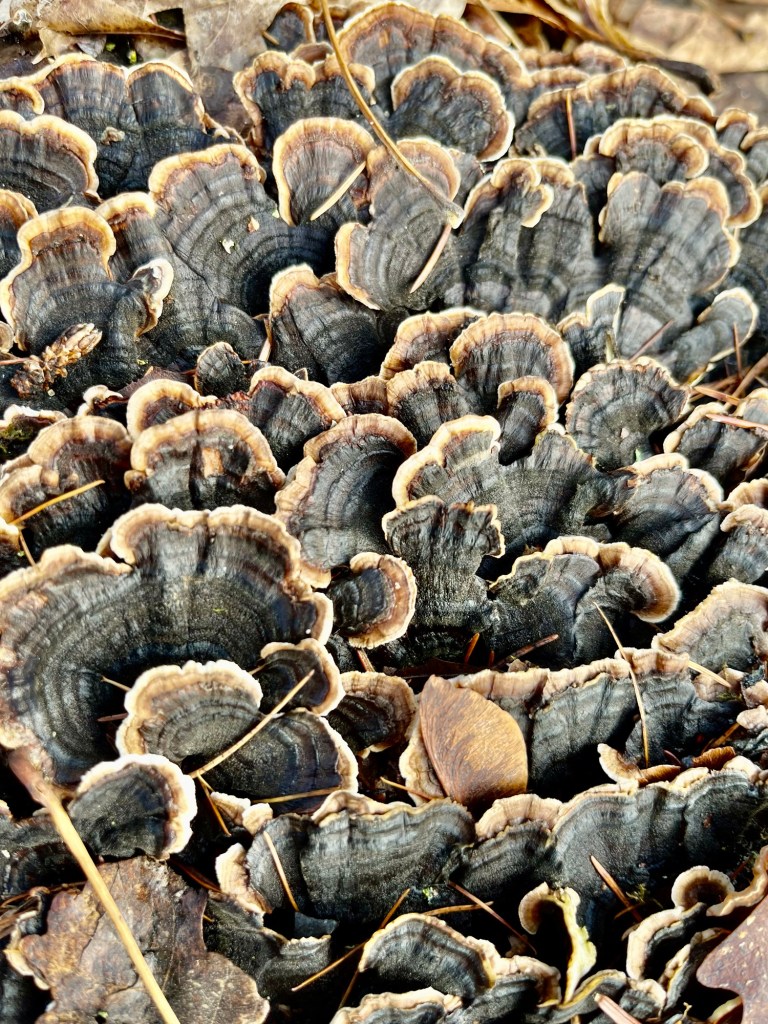
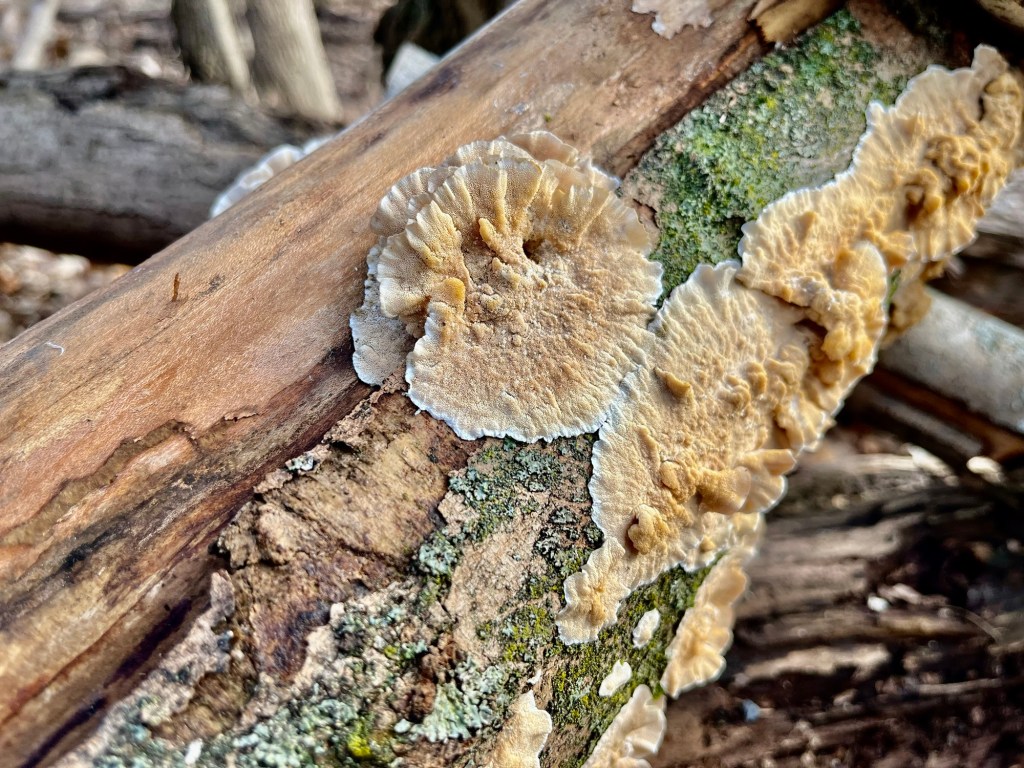
I haven’t decided yet through which linguistic lens I see the mushrooms (also masculine in Ukrainian). Even in the very early days of march, mushrooms are present and thriving, assuring me that life goes on.

And so do the mosses. I keep walking thinking that I am probably a one-percenter. After all, how many people outside our town live in a walking distance to a forest?
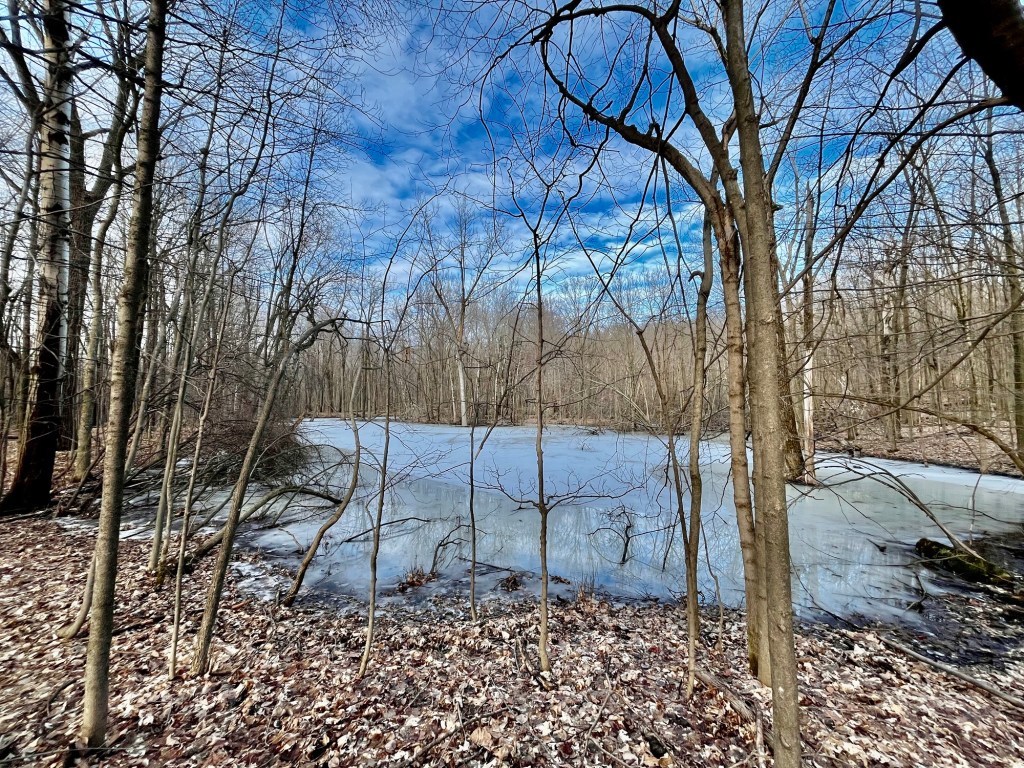
I may be wrong, but I don’t remember a pond at this particular place. I think it’s just an accumulation of snow and ice and water that creates a temporary illusion of a pond. Somewhere else in the forest there is an actual lake that isn’t one. It got overrun with algae and plants and is now slowly turning into a meadow. Here is a hollow that temporarily became a pond. I love how the forest constantly reinvents itself.
I took a different way back home. It is a bike line along a large water reservoir (the same that brightens the view of the gated community). It used to run along the backyards on one side and a wild growth: birches, sumac bushes, asters, milkweed, young maple and ash trees on the other. Now part of this wild growth has been destroyed and some developer is building luxury townhouses, another gated community with a view on sunset.
-
March 2
Mama sent me a video of the sea today. I watched it three times. I like thinking that there is a sea somewhere. There is always a sea somewhere, living, breathing, moving, making waves. What if the distance, the kilometers of land between me and the sea don’t separate us, but connect us?
I like thinking that my mama is now walking by the sea, breathing in the salty air, covering from the wind, poking pebbles with the tip of her shoe. I like thinking of her on the beach. She used to carry me in her body. We share the same DNA. So, in many imperceptible but important ways, there is a part of me on that beach today.
I like that there are no people on the video. We’re yet far off season. The sea is resting, undisturbed by the white-bodied northerners, impertinent children and busy crowd in the beach cafés. I used to live and work on French Riviera, I know the difference between the sleepy calm of the winter and the frenzy of the summer. I always liked the sea in winter. I always liked that in France you can take a two hour lunch break and no one would bat an eyelash. Nobody likes their work in France, so we know how to make the best out of the blessed two hour pause in the middle of the day. In winter, I would put my sandwich in a back-pack with a notebook and a pen, and would bike to the beach. I would leave the bike by a picket fence that was about to fall over, cross the strip of sand and find a dry and sunny spot on a large stone near the water.
Unlike the locals, I knew my time by the sea would not last forever. I didn’t have any special skills that would solidify my connection to it or would tempt me to stay. I didn’t sail, dive or snorkle and I had neither money nor ambition to learn. The beautiful thing in that relationship was that it was me who was temporary. I left, the sea remained. It still breathes and moves and makes waves. It doesn’t wait for me, but I hope that in some imperceptible important way it remembers.
-
March 1
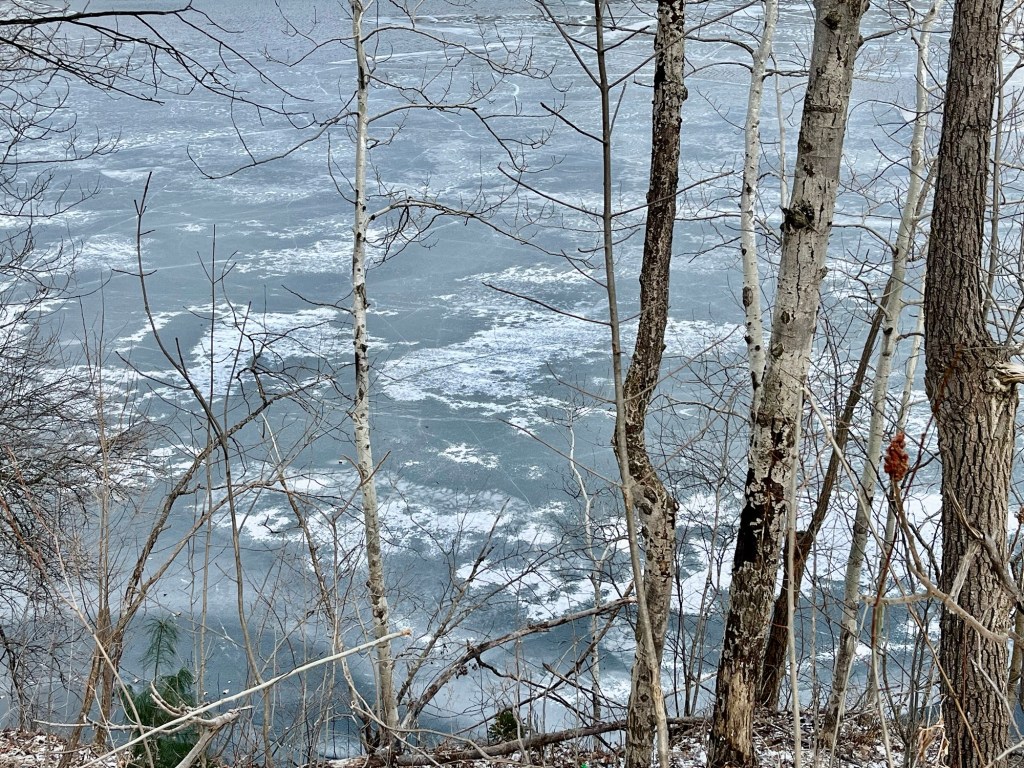
This week I have finished a third version of a 40-page learnings report for work, got a positive review on my first Intercultural Leadership assignment, took a Kanyen’kéha test and did a good progress on my second Leadership assignment. Also, I managed to sleep, excercise and eat greens almost every day of the week, which should at least partly account for my relatively stable mood and stamina. Yes, I have a right to be proud of myself. I may not be proud of myself at every given moment, but overall I think I did pretty damn good. I also got hooked on the new Netflix rendition of One day, which is worth mentioning here, since I have absolutely no one to talk to about that. So, about One day: I had read the book when it came out and created a huge buzz and I hadn’t particularly liked it. I can’t remember though, if it was because the book wasn’t that good, or because everyone else liked it and I wanted to contradict. I do remember that I genuinely didn’t like the film. I have not thought about it in the years since (there ARE many books that I come back to mentally on a regular basis, like The God of Small Things, Thousand Autumns of Jacob de Zoet, Shaggy Bayne, Jane Eyre or Gut gegen Nordwind). But lo and behold, Netflix puts the forgotten book into a 14-episode story with a “diverse cast” of talented Gen-Z actors, and I can’t get over it.
I notice how my attention to book genres swings depending on my overall state of mind and, I suppose, the sate of the world that hasn’t been great or even acceptable for a very long time. During my good periods, I feel intense passion towards non-fiction in the Community and Culture or Indigenous Voices sections, or towards good solid literary novels (for some reason, I love reading through Booker and Governor General Award shortlists, but completely ignore other literary prizes). In the bad periods, I am drawn towards horror, science-fiction or, as was the case in November and December, at the worst of my mental health crisis, “historical” romance novels. I think the deal here is not just the escapism, or rather it is not just escape from reality, it’s escape from myself. Those genres are foreign to me, they do not reflect me, so reading them I can pretend not to be myself, put aside my intense and tiring personality and be someone else, someone who reads on the beach of an all-inclusive beachfront hotel during the Spring Break.
Reading on the beach brought me back to the memories of our summers in Crimea. There was no hotel and absolutely nothing was included. We rented a small room from aunt Natasha, an emergency nurse who worked in Eupathoria and lived in a small military settlement with her always drinking husband (sometimes, without him), her rebellious daughter Marina and young son Zhenya, whom I intensely disliked for no apparent reason. I used to borrow books from Natasha’s library and smuggle them to read on the beach, because other than bathing the beach was boring. I was never particularly interested in building sand castles (I mean, real sand castles, I’m good at building methaphorical ones). So, I smuggled books to the beach, only adult books. I remember reading some biographical novel about Beethowen, crime novels, Dickens. The only book I was not allowed to take to the beach was Gone with the Wind, because it was rare and hard to find. So, I pretended to be sick and missed wonderful summer days and the warm Black sea to read the story of Scarlett and Rhet Buttler. Now Crimea is under occupation and I wonder what happened to aunt Natasha and her kids. Would they still remember us, if we met? Would they consider us friends of enemies? Do they still have the little flat we used to share during our summer vacations and the books that lined entire wall of their little living room slash bedroom slash guestroom?
-
February 28
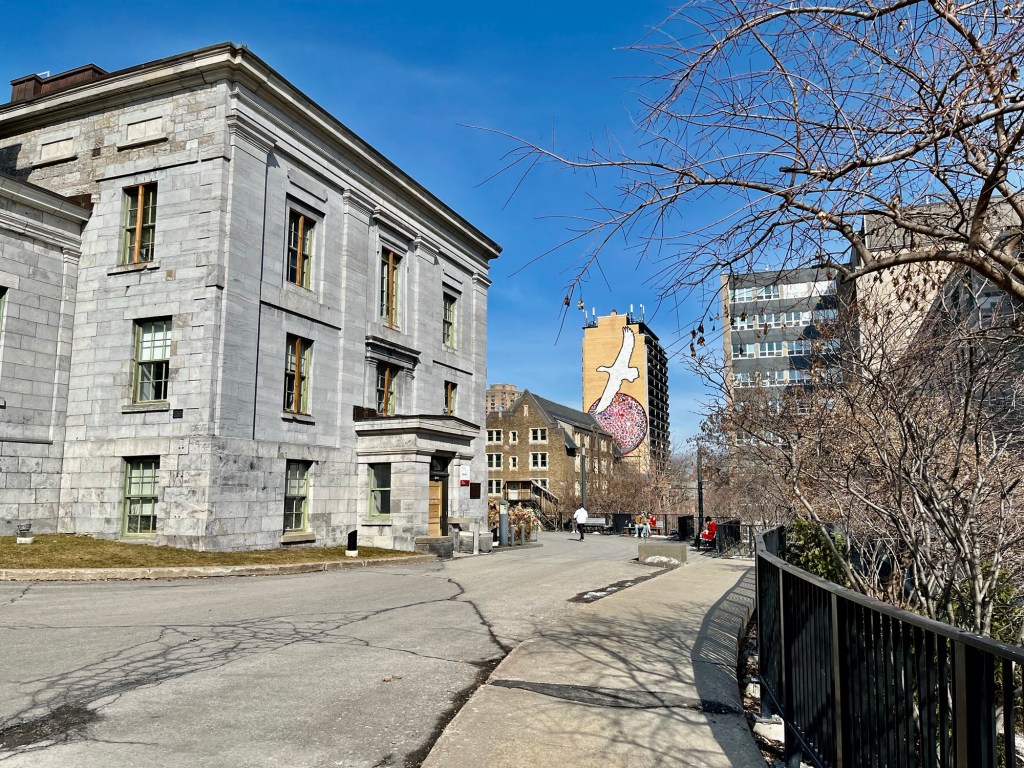
The picture is from yesterday, when it was sunny and untimely warm and the body enjoyed spring, although the mind understood how strange and bad it is to have spring in February. Today is humid, gloomy and very warm, 16 degrees above the average for the season, and the wind is howling something frightening. We’re expecting a flash freeze tonight and are almost placid about the possibility that we will lose electricity. Or maybe we won’t, in which case we will consider ourselves lucky.
These days, I have received several invitations from people I respect and for the opportunities that could open other doors. Usually, I would be torn between my inability to say no (I really do feel like I owe every person who asks me something) and my ambition that would push me to say yes to everything. Today, I was able to say “no, thank you, it sounds wonderful, but it is not right for me” and actually mean it. It is alarming that I do not remember another time I’d put my well-being above my ambition. I hope this is a start. So, let me write it down and repeat it:
not everything is for me
not every time is right
it’s ok to say no
saying no may empower other people to say no
there is more than one way to love people and more than one way to make a change
-
February 26
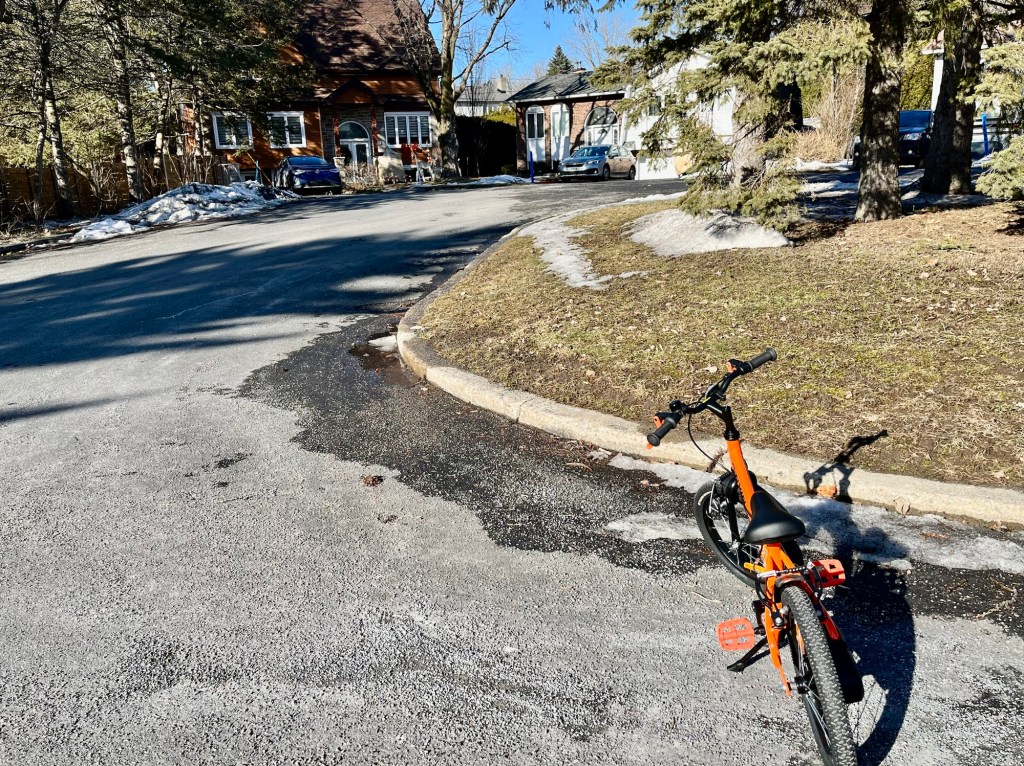
The little one is sick today, not enough to unsettle me, but just enough to stay at home and turn what was supposed a busy working day into a smooth drifting between cuddles, answering emails, playing and fitting some deadlines in between. It was such an unbelievably quiet day. A day that feels incredibly full and satisfying although objectively nothing happened. A day when we lived every minute without rushing through it. Thank you, my little troublemaker, for teaching me to slow down.
-
February 25
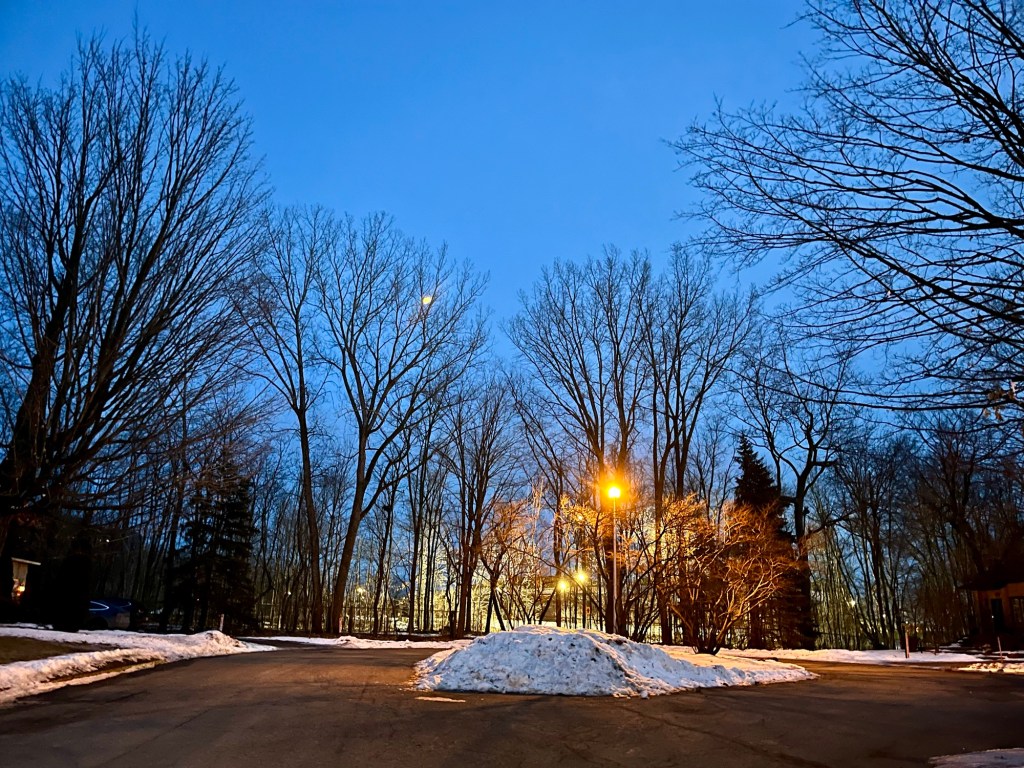
The weekend has been mercifully sunny. It still surprises me, although it shouldn’t, how much power they, the sun, the moon, the winds have on us. It still surprises me, how much time there is and how much one does when one has “nothing to do.” I start seeing the weekend as reconnection to kairos, full and expansive, uncensored. A time when one can grieve or rejoice without toning down or sweetening up. I’ve done both. I even spent a whole hour sitting on a couch and reading for pleasure and still had time in the evening to prepare for my Mohawk test and write an outline for an intercultural leadership proposal. Weekend is the only time I don’t feel exhausted. I start suspecting that there is something fundamentally broken in my relationship with work.
-
February 23
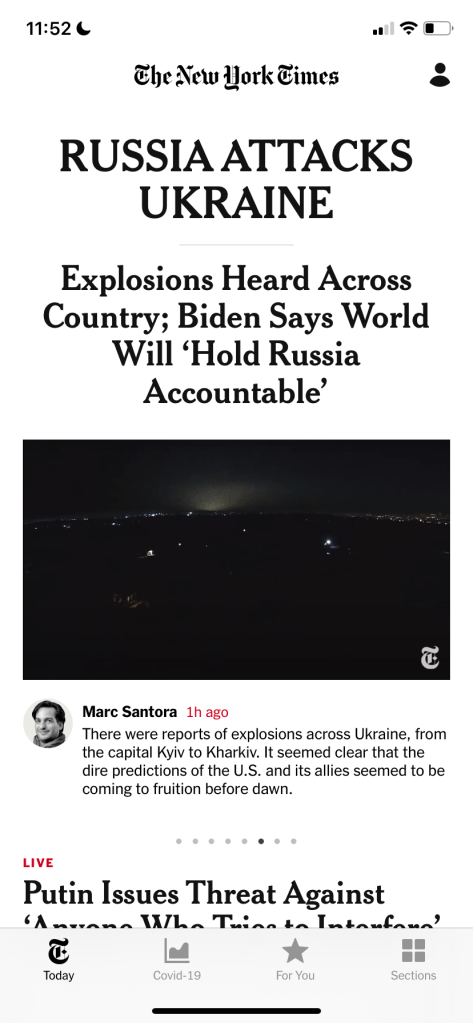
There is a seven hours difference between Kyiv and Montreal.
It was around 5am in Kyiv, still late evening in Montreal. I was sitting downstairs in my office, trying squeeze a few extra hours of work out of myself, before taking time off for spring break. That’s when I saw the news. I didn’t call anyone, not immediately, I didn’t move. I howled. That’s what I remember, howling and sobbing for a very long time.
I remember checking news every minute, then checking Facebook for personal updates, then texting, then waiting, then checking news, Facebook, texting, waiting, news… I remember Natashka hiding in the fields behind her house, I remember hearing nothing from Vika for ten long days and how I cried when she finally wrote back, I remember sitting in the hospital with my broken hand and getting updates from Olya who was trying to escape from Kyiv with her parents, I remember Natalya sending updates on her kids – her little Vira was only two at the time and so afraid of air raid alerts, I remember Olesya asking to pray for her parents in the occupied Irpin.
There is a seven hours difference between Kyiv and Montreal.
I woke up every day to the news of the fresh atrocities. I remember having a panic attack in the middle of the mall – I was supposed to meet some friends to talk about a difficult work situation. A few minutes later, I got the news of the bombing of Mariupol Drama Theatre. When it was evening in Montreal, the stream of news slowed down to a trickle. I remember laying down next to my son, who still slept in his baby cot, and praying, trying to say as many names as I could think of. Name by name by name by name.
I used to save the screenshots of news articles, photos, facebook posts about people killed by russia with their names and life stories, artwork that was even more heartbreaking than photos, and poetry. I have hundreds of those on my phone. Some of the artists and poets have since been killed in the war. 730 days is a very very long time. God have mercy on us.
-
Subscribe
Subscribed
Have a WordPress.com account? Log in now.

