January 15

I am trying not to fall back in a corporate fever trap by placing accents on what’s important. Children are important, calling mom is important, being outside, movement, eating, replying to non-work messages, slowing down, breathing. Reading, journaling, taking pictures of fleeting moments, anticipation.

And sleep, how could I forget sleep?!

Good night

January 13

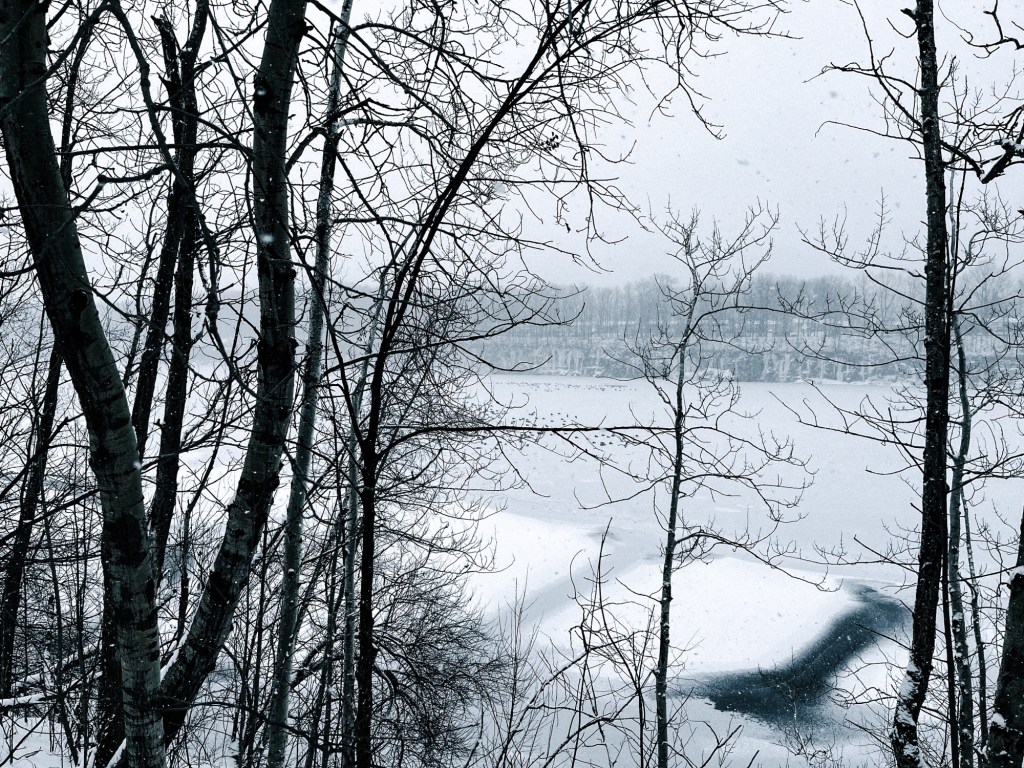
Rain on snow then snow on rain… I wonder if we will have a week of decent winter this year.

It is good to see old friends and remember that no matter how old and how long ago, they are still friends and they keep a part of you.

Conjugating the Mohawk word – nòn:we’s (like) with person-to-person pronouns. I like you, you two like me, she likes you all, they like all of us, you and I like him. I imagine what it might be like to be a fluent Mohawk speaker. To place every action, feeling and intention in the web of closely knit relationships. Pronouns are not external, independent words – they change the verb. I like you is not the same verb as she likes them. It is not the same feeling either.

Coming back home in the evening to Leonard Cohen’s concert playing on TV. I wonder what he would have thought of it all.

January 12

Today I feel happy, while I feel all other things including grief, confusion, anger, exhaustion, hope and hurt. Still, today I feel happy because I created a framework for mutual learning and accountability of our grantee partners. This framework is simple, written in human language, it venters love, trust, humility and collaboration.

I have not yet shown it to anyone, but I feel that I did my best work. That for once I managed to translate the language of my heart into the professional codes of my job. And now, while this framework remains my brain-baby, still hidden from the world, even from my friends and co-conspirators, I want to note this. Regardless of what other people think about it, it is a good work. Regardless of how it gets distorted by corporate colonial system, it is a good work. It is good, because it makes me feel whole. It is good, because it bridges the gap between the brave, genuine and vulnerable me and the professional me. It is good, because it is me without a mask. It is good because I wrote it not to impress someone or show how smart I am or test-drive new fancy concepts – I wrote it from the heart, from everything I learned in the past three years, from my place of trauma and from my place of compassion. It is good because it is healing.

January 11

I’ve been walking on this street almost for a year without noticing the water reservoir on the roof of the building. I wonder, if there is a word in some language that means “to see for the first time what had always been there.”

I had promised myself to dream up some sustainable and livable world for my son in 2080, but this will have to wait. Today, I learned about the life and philosophy of Ikkyū, a 16th century japanese zen master. It started with a morning podcast with Michael Meade, who was speaking about the Kairos and quoted the monk:

How many times do I have to say it?

There is no way not to be

Who and where you are.

Ikkyū was one of the most unconventional figures in the history of Zen. In the time when Zen was politicized and commercialized (apparently, in 16th century Japan, like in 21st century Turtle Island, people found ways to make profit of everything). Ikkyū was among those who resisted the weaponization of Zen and its contortion into a rigid academic and hierarchical structure and insisted that Zen was a lived and living experience.

From reading his story, it is hard to understand whether Ikkyū was a show-off, a madman or a humble genius. In all likelihood, he was all three. And if I’m honest, Ikkyū sounds more like a mythical archetype, than a real man. There is a number of these fascinating rebellious geniuses: Diogenes, the founder of Hassidism Baal Shem Tov, Ukrainian travelling philosopher Grygory Skovoroda. Jesus of Nazareth could probably be put in the same category. These men remind us that true freedom and enlightment require radical imagination and the courage to break away from the system. Ikkyū also reminded me that one thing I can never stop being is myself.

Other than that, I spent my day checking the updates about ICJ case agains I*rael and reading about western powers bombing Houthis. I’ve been taught to think about Houthis as pirates and terrorists, but now I’m questioning the biases I’d internalized.

January 10

Today, during the webinar on Inner Development Goals, the presenter asked us to participate in the activity to illustrate long-term multigenerational thinking and decision-making. He asked us to imagine the youngest person that we are close to and the oldest person. We were to reflect on what the world was like when the oldest person was the age of the youngest and what it will likely be when the youngest will get to the age of the oldest. Also, he asked us to imagine what we would like the world to be at that point of time.

Naturally, I thought about my almost-five year old son and my seventy-one year old mother, not because she’s the oldest person I know, but she’s the one closest to me. 

My mother was born one year before the end of the reign of Joseph Stalin (I had never realized that before!) in a small Ukrainian town called Radomysl. When my mother was the age of my son, she was growing up in a country ruled through oppression, terror and ideological brainwashing. It must have been the time when the survivors of the GULAGs were slowly returning to their places of origin. It was a time when the USSR and the USA were racing towards sending the first man to space. It was also the time when my mother’s family couldn’t afford simple things like a washing machine or a refrigerator. They had running water, but the toilet was outside. My mother told me that her biggest dream was to have a store-bought doll -only her Jewish friend had such a luxury, she had to make do with a home-made ragdoll.

Yet, it was also the time when they lived simply and sustainably. When I was young, my mother used to take me to Radomysl to visit her aunts (her own mother had passed away before my birth), so I remember the houses and the yards vividly. The houses had no front yards. The back of the house was facing the street, whereas the front entrance faced the backyard. There was a chicken coop, some fruit trees, berry bushes and strawberries and many rows of sensible vegetables: tomatoes, cucumbers, cabbage, carrots and, of course, beets. People who had space planted potatoes. Potatoes and cabbage were synonymous with Ukrainian survival not only during my mother’s childhood, but also during mine. At the edge of the vegetable patch people would plant corn and sunflowers. People hauled most of their food from the local market (shops were truly miserable). In the summer, they made jams and preserves- it wasn’t some kind of hipster utopia, just simple survival. 

My son was born in one of the most prosperous countries in the world one year before the global pandemic. He is growing up in the time and place where the stores have every kind of fruit and vegetable in any season, where Netflix serves him entertainment à-la-carte at will, where distance and time difference almost disappeared thanks to advanced technology. It is also the world where the ecosystems are dying, the facism is coming back from the oblivion, the inequality of growing and genocides are happening in front of our eyes. My son will reach the age of my mother in 2080. As I type this date, I have a vague sense of dread and no desire to dwell on the details. Will there be glaciers? Virgin forests? Life in the ocean? What will the temperatures be like? Will there be snow? Tornadoes? Will he be able to vote? Will there be a nuclear winter after some power-crazed male finally pushed the button? I do not idealize my mother’s childhood, but somehow it sounds less dire than my son’s old years.

I will take a break now and tomorrow I will try to think up the world I want in 2080.

In this darkness something is emerging. I can’t name it, I struggle to describe it or to make out its contours, but I can feel it. There is something being born.

January 9

I wish I could get under covers and stay there until April. No, until March, until the sap starts running in trees.

There is a winter storm raging outside. For my old performance-oriented self, snow storm was a distraction, an irritant putting in danger my carefully laid plans. For my new self, it is a reminder of who I am in the universe. I am not in control. I am not there to succeed at all cost.

Today we are gathered and see that the cycles of life continue. There are no straight lines, just cycles.

For the first time of my life I feel humble and grateful to be humble.

January 8

I don’t remember ever feeling so lost, lonely and disconnected at the start of a working year. I can only list the symptoms, without trying to analyze and understand them. On this first “back to office” day I felt: indifferent, discouraged, misunderstood, frustrated, resigned, “just push through it”, happy to realize it’s 12pm and I can take a break, even more indifferent, detached, “just leave me alone,” “why did I even bother to say anything,” and honestly genuinely scared of the prospect of going to the office tomorrow and facing all the small talk, how are you’s and unmitigated enthusiasm of the people who delude themselves into thinking that the new year somehow means a clean slate. I guess I should add “mean” to my list of symptoms. I don’t know if it’s a burn-out, a midlife crisis, a late-onset neurodivergence (is that even a thing?) or a sign of something darker, deeper and more collective. One thing I do know: I don’t want to ask for help or have to explain myself, but I do want to understand what is eating me and I need someone to get there.

127

In the past 127 days I’ve experienced

The death of a friend

The death of a black and white cat called Echo

The death of another friend’s nine-year old son in a freakish accident

The death of Israeli teenagers at a music festival

The death of countless Palestinian children

following the death of Israeli teenagers

as if the latter somehow atoned for the former

The death of a Ukrainian poet on the frontlines

of the war that I once had thought would last only a couple of weeks

but now I feel as if it would last forever, until it swallows the every last one of us.

Nothing will ever make any of it right

Nothing will ever atone

So, instead of fighting over who of us hurts the most

Can we sit together in wordless mourning

In an ancient ritual of sadness, love and humanity.