October 20

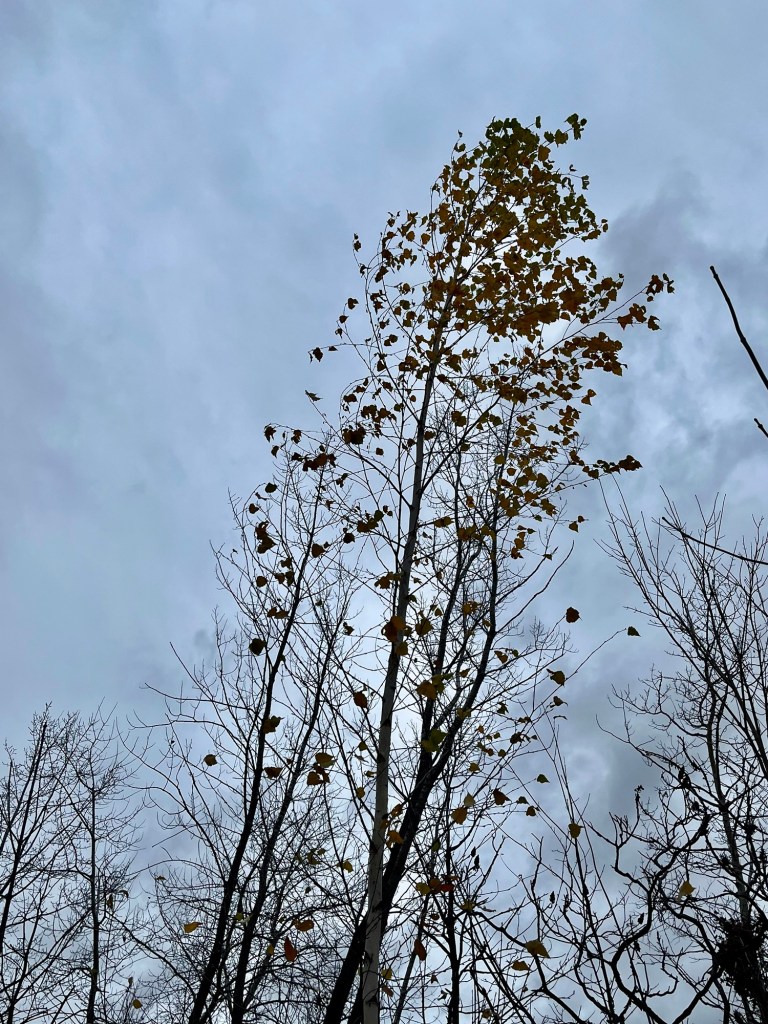
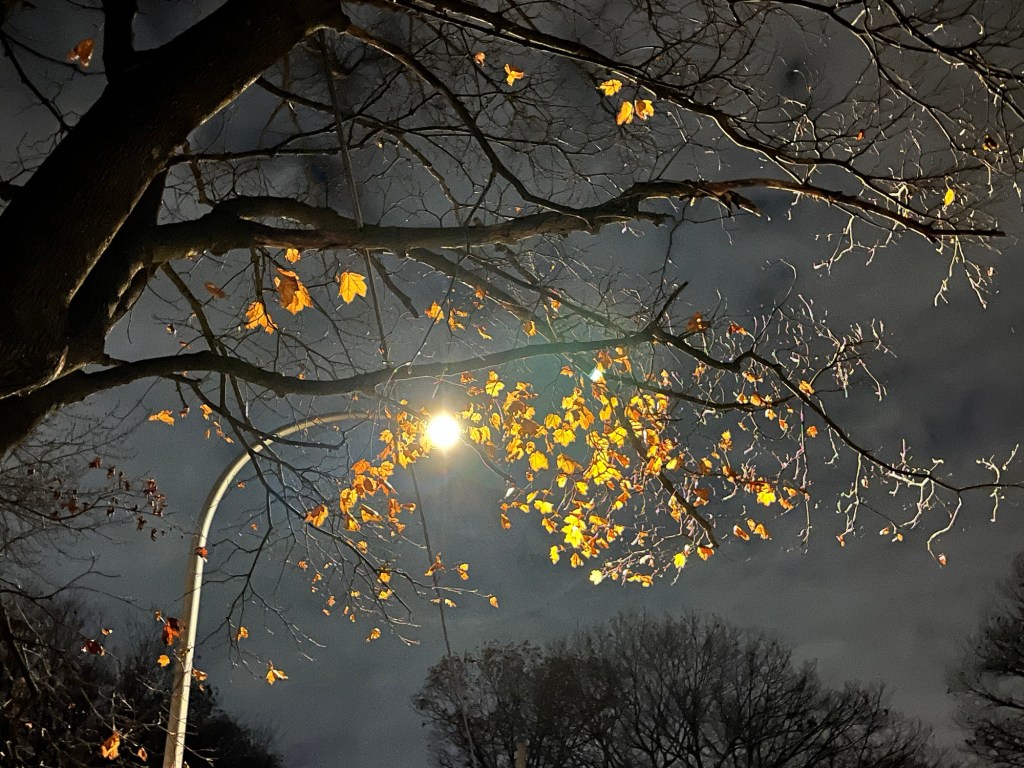
What is it about flame-clad autumn trees

that makes them look bigger than they were in summer

What is it about the particular thinness of air

that makes me rub my eyes

What is it about the light and all this transparency

that squeezes my heart

I would rather

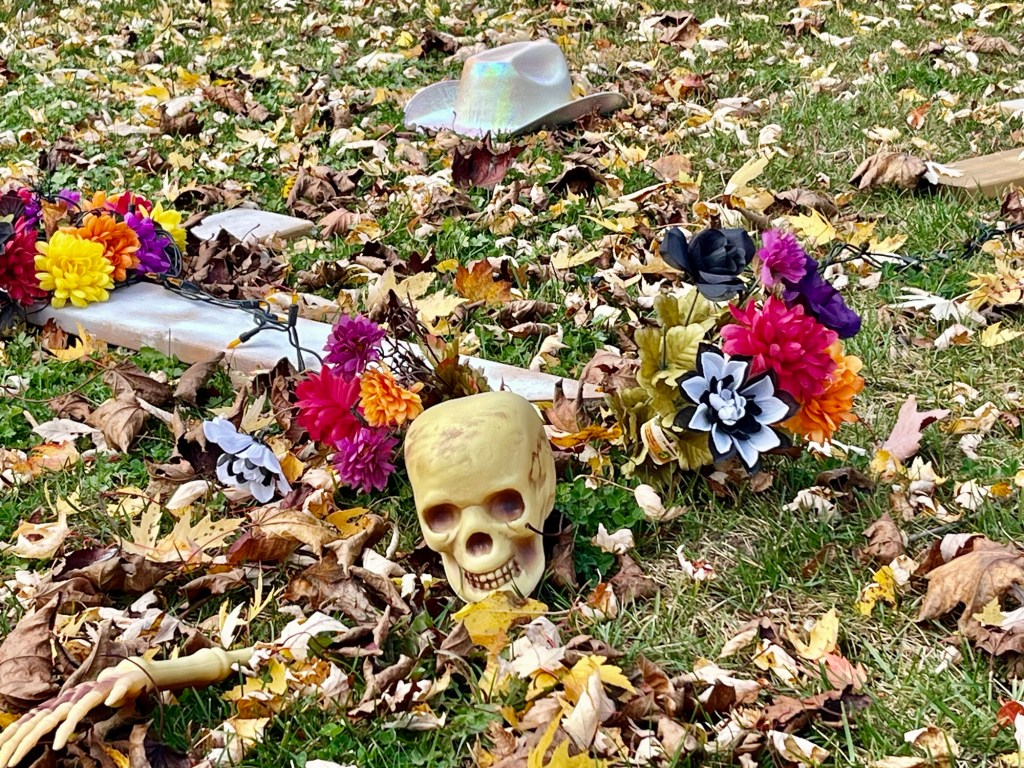
love the living world in its dying

I would rather

hold it close to my chest with its comforting warmth

Breathe its particular odour of gentle decomposition

I would rather

stay in the homely mess of here and now

I would rather care

than win

I would rather falter

than triumph

I would rather crumble

than outlive everything that loves me

I would rather accept the goodness of now

Than hope for the future at the expense of the present.

I have believed in the afterlife for way too long

In my youth, I stood by the entrance of the subway station

handing out brochures and telling strangers about heaven

While avoiding their eyes

Stifling my own doubts

And artfully ignoring the hell around me

I may have lost that faith

I may be losing the hope I have left

But with every falling leave

With every full moon

With every departing flock of geese

My love of dying things grows stronger.

October 19

I had a nightmare tonight, the kind that wake you up all breathless, scared and grateful that it was just a dream. My daughter has those. In my nightmare there was a crowd of children and some adults, it looked like a kids party. Then the evil came, and I started shepherding the children away, taking them out of evil’s way. I remember dreaming about picking them up, one by one, putting them on a couch, giving them toys, asking them to stay quiet, to stay put. When I finally huddled all children together, I turned around and realized that all other adults were gone, just disappeared. I was alone, standing between children and the evil that was staring at me with glee. That’s when I woke up.

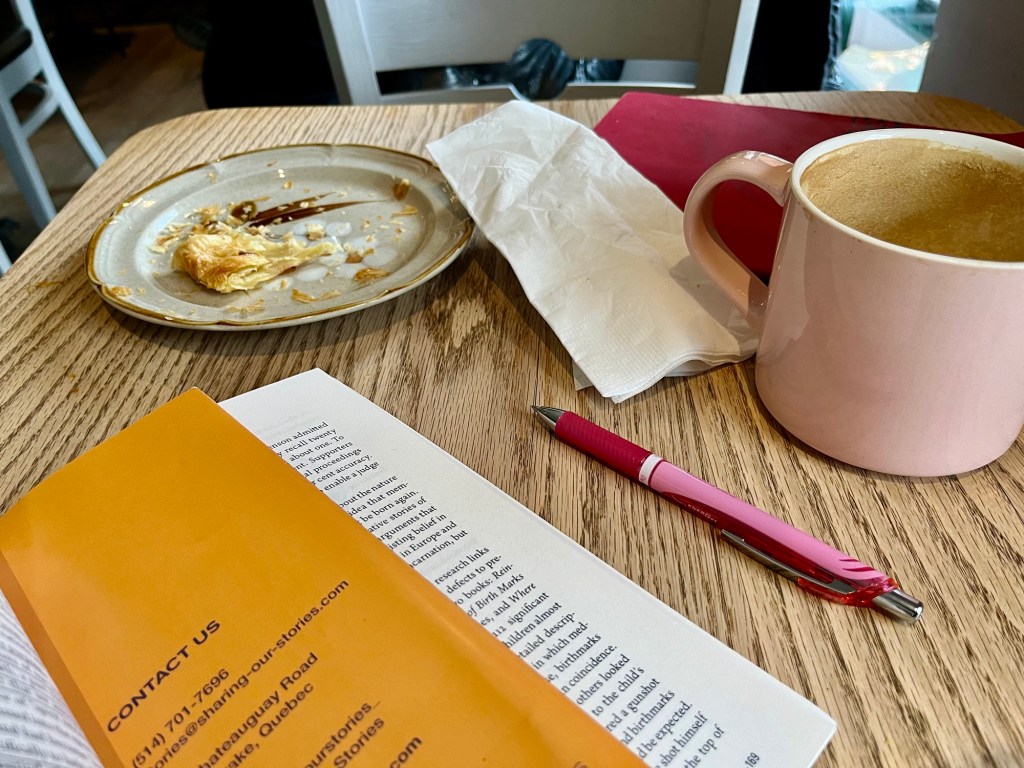
During my Saturday morning coffee and catching up on the school reading the chapter was about Windigo, the cannibal spirit of the Anishinaabe stories. At the table next to me a man was talking very loudly about this great time management software his company was selling. Not only this software creates timesheets for employees, it “helps” them account for every minute task. Imagine, the man was saying, you’re working on a project and your phone rings, some personal call. Our software stops the timer, so that your call doesn’t count towards your working time, then restarts it again when your call is over. Imagine how much easier it is, than trying to remember every little thing you did when filing your time sheet on Friday. How much easier it becomes to control a factory with 500 employees. We just count everything. I looked up from my Windigo page, incredulous. Life imitating art.

I started listening to an audiobook Imagination. A Manifesto by Ruha Benjamin and learned the term long-termism. Long-termism is a philosophy that allows very rich and spoiled Silicon Valley brats not to give an f about the crisis that is happening here and now, as long as they can invest their money and their brains in some far away technocratic future where their legacy will be carried on by “digital descendants.” The idea of it was so dystopian that it made me laugh out loud. Wow, so the Silicon Valley dudes stole the basic technique of the original colonizers, aka Christian missionaries – focus attention on the uncertain, vague and imaginary afterlife, so that you can ignore, destroy and plunder the tangible and beautiful world you have in front of you. This made me think back to the conversation I had earlier this week, the one about the love of the dying things. I would rather love the fragile, dying and undervalued present world than hope for some future one where only the fittest survive.

October 18

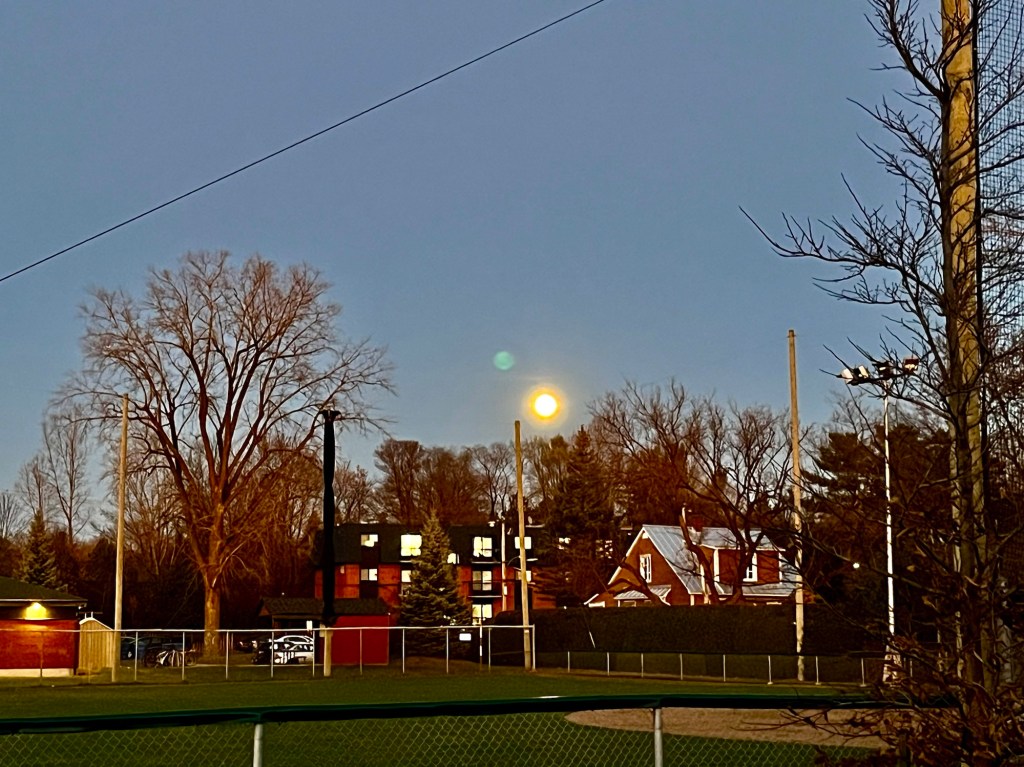
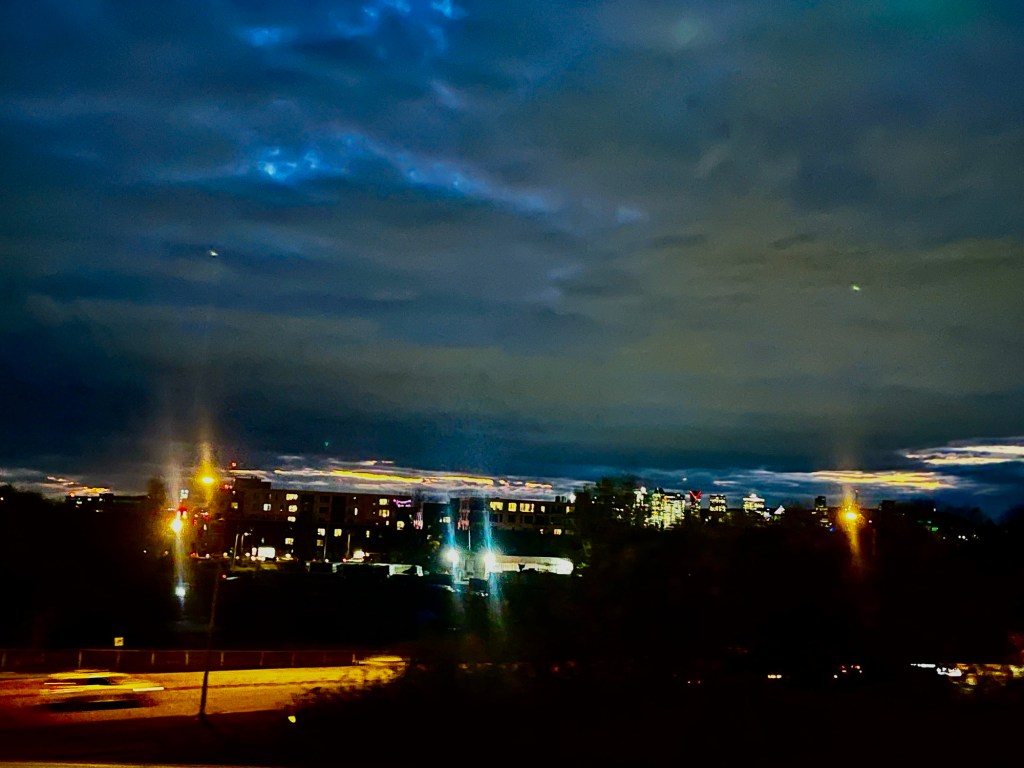
The two moments that stopped me on my tracks today: this swing in its gold and lemon shiny surroundings and a giant, impossibly yellow hunter moon calmly looking over a brightly lit football field.

Today I had to force myself to go for a lunchtime walk. It was a beautiful autumn day, the “so beautiful it’s almost sad” kind and I couldn’t unglue myself from my computer screen. I realize that I am getting into an obsessive phase when I live and breathe my work. I’ve been there before. I stop eating. I think about my work while walking, sleeping, playing with my kids, I just can’t stop. The work starts consuming me. This week, there were several times when I forgot to eat or simply decided not to. There was a morning when I got up and ruched to write up an application form. This is not healthy. I love my work. I am passionate about creating new worlds, following the threads of thinking into the unknown, I love feeling how clarity emerges through the fog of complexity. I love feeling bold and creative, “determined and afraid of nothing.” Maybe, because I never feel this way about myself or in relationships. But I have to admit that this is another way I avoid being present.

I was looking at the sunset over reservoir today and thinking of something I said in a conversation not so long ago (funny, how every advice we give is actually the advice for ourselves): it is hard to let go of a good thing. My work is a good thing. It is good for me and for people around me, but I have to let it go in order to be present in my life. I don’t want to quit, I am not quitting, but I have to put a loving boundary between the thing I love and myself. I don’t want to miss another brilliant autumn day because I was obsessing over difference between community mobilizing and organizing. I don’t want to walk through life without noticing life. The cries of the departing geese. The purplish red of wild sumac leaves. The changing colour of the sky: from pinkish to turquoise to dark blue. I want to be present.

October 17

I saw a black cat with a white nose and chest tonight. It’s the third black and white cat I’m seeing for the past week. This one was young, friendly and curious, he approached me and let me pet him. Which made me cry uncontrollably, because we’re around the anniversary of Echo’s death and all these black and white felines are signs of a complex process of grief and remembering. I always tell my kids that we shouldn’t stop loving the ones who are dead. I love you, Echo, I miss you.

Tonight is Hunter’s moon. I’ve read that it stirs passions and brings courage. Which made me think of Kai Cheng Thom’s explanation of the word courage, that it comes from French cœur and rage – heart and rage. My heart feels very on edge. There was a moment today when I was literally trembling with anger and vulnerability. There was a moment when I was walking through the lunch hour crowd with music on the highest possible volume in my ears. Ukrainian music that got me through the crazy turbulence and trauma of my youth, through two revolutions, through the first months of war when I couldn’t sleep, when my throat hurt from howling. I listen to this music, not often, but from time to time, to remind myself who I am.

There were beautiful WhatsApp threads and a message from Rosie and a tiny moment of lucidity near a cedar bush, when I realised that I don’t just live, I AM loved and I need to accept this as a basic fact of reality.

October 16

There is a random thing that makes me wildly joyful. Coming into a coffee shop or another public place and hearing a song from my own playlist. This feeling of serendipity, of instant connection, of being known by the universe, of being present in a particular time and place, of seeing my own soul in the mirror of reality lasts long after the song is over. Sometimes for hours, sometimes for days. This tiny little coincidence is so important to me (precisely because it always comes unbidden and I have no way to make it happen) that I can tell exactly how many times it happened this year (three, including today), where and when it happened and what the songs were. I’ve been struggling to articulate what belonging looks like… but here it is – a drop of pure, concentrated belonging dropped into the apple pie of my reality.

Speaking of articulation, i’ve had the weirdest and most wonderful conversation with someone who was terribly late and terribly apologetic (also, terribly young and terribly wise and sad for their age). We were both rambling and feeling that we were saying too much and nothing (they literally apologized every time they spoke). It made me think of butterflies. We struggle to put things into words to make ourselves understood, to make sense of ourselves, but the moment we do it we confine the complexity of what is going on to the limits of our language. We pin the butterfly. The pinned butterfly is still beautiful, we can admire it up close and for a length of time, but it’s dead. The magic that made its wings flutter is gone. This leaves me with question of how do we leave things intentionally unsaid. How do we create space for preverbal. A home for our ancient and powerful selves that don’t know how to use PowerPoint, but can communicate with spirit.

Part of my conversation script these days is asking people what they are hopeful about, so I did that. They answered, or rather rambled the way we were rambling all along and then they surprised me by saying: What about you? What are you hopeful about? I am not used to people flipping the script on me in this manner, so I panicked. Because, God, this question seems so simple when you ask it and so impossible to answer when someone asks you. I thought about home and the three years of war and the growing separation with so many friends lis and the dying ecosystems and about my children and about my cat who died last autumn and I said, truthfully, that even when things are dying you can still love them. And this gives me hope.

October 14 – thanksgiving

On the Canadian Thanksgiving, a rainy Monday, I am sitting on the floor staring through my backyard window at the yellow, pinkish-red and bright orange – the colours of gentle decay. I am trying to meditate, something I don’t know how to do. I am trying to shut off my thoughts and focus on my breath – as soon as I do that, my breath becomes ragged and thoughts flood in, so I start to write. I am thinking of home. I am thinking of the phrase « the center of the universe is everywhere ». I am looking straight at it: a worn-out deck, a trampoline full of fallen leaves, the whole extent of my backyard – unmowed, unraked, overgrown with all kinds of wild greenery, including goat weed that mocks my attempts of taming it and goldenrods that I love too much to domesticate. I hate mowing and raking. I am lazy when it comes to gardening or yard work, but there is more to it than laziness. There is longing. There is an acknowledgement of grief and guilt I am feeling every time I touch the body of the earth with a sharp cutting object. I am thinking of the ecosystems that grow and proliferate in my unkempt backyard, at the centre of the universe. I am thinking of home. When I was young, lonely and unhappy I always thought of home as something yet to come, something in the future, a distant place where I would find myself, where I would belong. I grew up and moved away, then away, then away from those previous always, further and further. And somehow I started thinking of home as something in the past, something I lost without realizing I had had it in the first place. Something I am afraid to never be able to come back to.

I am looking at the leaves covering tall grass flattened by the rain, covering soft, humid and generous soil. Like a layer of skin covering layers of tender tissue, all the way to the heart. Heart is another word for center. Maybe I am not lost. The center of the universe is everywhere. Maybe, instead of running in search of home, all my life I’ve been running away from belonging. Because belonging implies responsibility. Belonging means I should stay. I have never learned how to stay. I have perfected my skills of longing, not belonging. This be, these two tiny letters change everything. Be as in being.

October 12

I have always wondered what belonging must feel like. To feel attachment to a place and people, to rest secure in the permanence of it, to see with clarity into your past and your future. What it feels like to feel seen, accepted, fully understood, one of us, them, whomever. I am growing comfortable with an idea that I will never feel that. This is not my story. My story was written before me. My story is the one of a family that lost connections with its past , was ripped from its land by wars, famine and terror, by the imperative of survival in an inhuman system, by man-made ecological disaster, by personal tragedy, by historical upheavals over which we never had control and finally by sheer desperate longing for a better place. My story is the one of separation and of healing that separation. I don’t think there will be a happy ending at the end , a place I can finally call home. But I hope that there will be acceptance, the reconciliation with the idea of my own spiritual homelessness.

September 26

I don’t think I will find the words.

Sitting cross-legged with my head swung back, staring at the tree leaves trembling to the rising beat in the last rays of the setting sun. Do you call that a meditation?

Walking along the shallow brook. “Your ancestors are walking behind you.” I can almost hear their steps. Two Viras. Both stocky, with broad round faces, high cheekbones, clear eyes, strong hands, thick calves. Beautiful, strong like the earth. Slavic women, made of the most fertile soil on Earth. Everywhere I walk, they walk behind me. “You can lean on your ancestors. How does it make you feel?” Less than alone. The opposite of alone. I have heard this message twice in the past two days. What are you saying, ancestors?

I turn right, I cross the bridge, then, on the other side the song begins, unbidden, catches me unaware. У мене немає дому. I start crying, harder and harder, trying to loosen the tight knot of grief, rage and desperate longing in my throat. I am trying not to sob, not to attract attention. If someone asks me, I would not be able to explain. I am crying for my lost home. For my people. I am crying to let go, to free myself from the things I will never be free of. Обійми мене. I am raising the volume all the way up, until my ears hurt. The voices of my youth are screaming. So much bass in their guitars, so much pathos in their vocals, the generation that never stopped hurting.

I guess I found the words, after all.

September 25

What I want remember from today is sitting on the floor in my therapist’s room (the word cabinet sounds much too formal, masculine and colonial and not at all fitting her), inhaling a faint smell of burning sage and telling my life story, year by year, milestone by milestone, piece by tiny piece. The parts I experienced, the parts I remembered and the parts I did not know as facts, but as some intergenerational knowledge. It felt powerful, just to hold those pieces together, to lay them out in the open, b ‘cause once I was able to hold them, I knew they were mine. I could look at them without pain, without shame or regret, but with recognition and acceptance. They are mine. And once I held them, once I claimed them, I knew I could do something with them. I can’t do anything about them, but I can do something with them. And this, I believe, is healing.

September 21

I don’t know if it’s my body’s way of processing this past week, or the first signs of the sickness my daughter had been spreading around the house, but today I feel heavy, slow and sleepy. I gave up on going for a jog. I may give up on my walk as well, or shrink it down to a stroll around the village pond around sunset. I had to go to the library, but the thought of biking felt like too much, so I walked.

I feel heaviness at the back of my head, around my nose and jaw, my arms and legs. I don’t like the idea of getting sick, because it will come with the imperative of rescheduling meetings and the next therapy session. Still, whatever the cause may be, I decided to lean into the way I feel. To embrace the heaviness. To lay back literally and metaphorically. To learn whatever it is I need to learn. To treat myself with sleep, slowing down, doing nothing and tangy herbal tea. To rest.