I decided to document this highly emotional journey from job-addiction to, hopefully, freedom and a place of thriving. So, today, I drank three cups of coffee, discovered that I concurred, at least temporarily, my fear of saying no. Chiefly, because I am no longer desperate to be liked. I cancelled many plans, without feeling frustration. I bought a new notebook for my future job – it felt like a ritual. The notebook is sky-blue. I felt silenced and erased by my superiors and I cried, just once, after receiving a message full of love from a colleague.
Then, when the day was almost over, I saw this. Tu t’en sors bien – you’re making it. I’ve been smiling ever since.
I am now in the process of leaving a job that I loved. I loved this job deeply and with passion. I was very good at it. This job brought me joy and meaning, but it also hurt me and traumatized me in many ways. It was one of those relationships that blurs the line between love and addiction. Where your friends keep asking you to leave your job and you get angry because they don’t understand. Where your mum asks you to take it easy and you promise you will, instead you loose sleep and work deep into the night and check your outlook compulsively. Still, you love it until one day you don’t.
I was lucky because I could leave when I couldn’t go on anymore. I could leave holding my head high and without much sacrifice. The way out was there, the door opened when I needed it most. Now I am leaving my job, feeling sad and hopeful and frustrated and nostalgic and exhausted by this tsunami of emotions.
I feel a pinch in the heart, from time to time, an anticipation of loss and a surprise at how I feel the saddest about leaving behind small and random things.
I will miss Rose de mai – a small coffee shop in the Petite-Patrie neighbourhood of Montréal, where I was just once, by accident. It has an abundance of plants and the best home-made tiramisu I ever tasted.
I will miss coffee dates with Tina, my partner at the City of Montreal.
I will miss filling my Thursdays with neighbourhood visits, especially waking from the whatever metro to whatever meeting place, noticing local architecture, shops and people. Montreal is a great place for a middle-class nomad.
I will miss the feeling of emptiness and expectation close to the end of the day, when it’s too late to start a new task, but too early to go home and one can have a last cup of coffee and reflect on one’s day.
So, in the end, what I will miss the most is not money or connections or the feeling of power, it’s freedom of movement, feeling connected to a place and coffee.
In Kanyen’kéha (the Mohawk language), there are different verbs for acting slowly and acting quickly.
Wakatihsnó:re – I am quick to act
Wakatihsá:yen – I am slow to act
The pace and rhythm are embedded in the verb itself, they are not just adjectives that can be dropped and added at will.
My rudimentary language of Kanyen’kéha does not allow me to imagine possible contexts for using these verbs, but my imagination easily draws parallels. Most of the time, I wakatihsnò:re : I am quick, reactive, swept off my feet, unable to slow down, torn between fatigue and frustration. By contrast, these few days of the new year I wakatihsá:yen – act very slowly. These days, I find slowness and nothingness particularly appealing.
The slower I move, the more powerful I feel, like a well-rooted tree, unmoving and leafless, but very much alive under its winter nakedness.
Like many indigenous languages of the Turtle Island (North America), Kanyen’kéha is holophrastic, that is, a single Kanyen’kéha word can express a complex idea or a phrase that would require many words in English. A single verb can express a lifestyle of wholeness, healing and liberation: I.ACT.SLOWLY.
Sometimes I am try to imagine my day as if it consisted only of Kanyen’kéha verbs:
I slowly walk on fresh fallen snow
The sky slowly turns from white to pink to pale violet
Winter slowly turns into a false spring, then into blizzard
If I were to choose one day to remember the year 2022, I’d choose the 30th of September. Rose came from somewhere in Ohio, or Kentucky, somewhere in the middle of the Turtle Island, to see me. She made it sound like not a big deal, like she was just dropping by on her way to somewhere, like she had other reasons. That’s what I believed at first. It was after she left that I realized she came to me. That I was the reason she flew to Montreal.
I took a day off work. I met her downtown, on Square Victoria that wasn’t as pretty as I remembered it. Rose, on the contrary, was the same, she didn’t even look older than I remembered her, fifteen years ago. She was wearing the same makeup and it made me realize I wasn’t wearing any and probably looked tired. Still, she said I hadn’t changed.
Rose asked me what it was like to be a mother. I had not expected this question. I didn’t know what to say. No one ever asked me that before. That’s the thing about living far away from home: everyone who can ask you what it’s like to be you now is so far away, you barely get to talk to them. Also, they have their own problems.
I haven’t answered Rose’s question, but I think of it in the moments I feel most present in my life.
The most remarkable thing about Rose is her voice. It’s a storytelling voice. It rises and falls with the rhythm of the story, fills with anger, with laughter, with the hilarity of life situations, with smells of her home. It is so loud – I am certain everyone in the coffee house is listening in, but no one dares to interrupt. At some point of the story it rises to its climax, followed by a burst of laughter. Rose’s laughter sounds like an explosion.
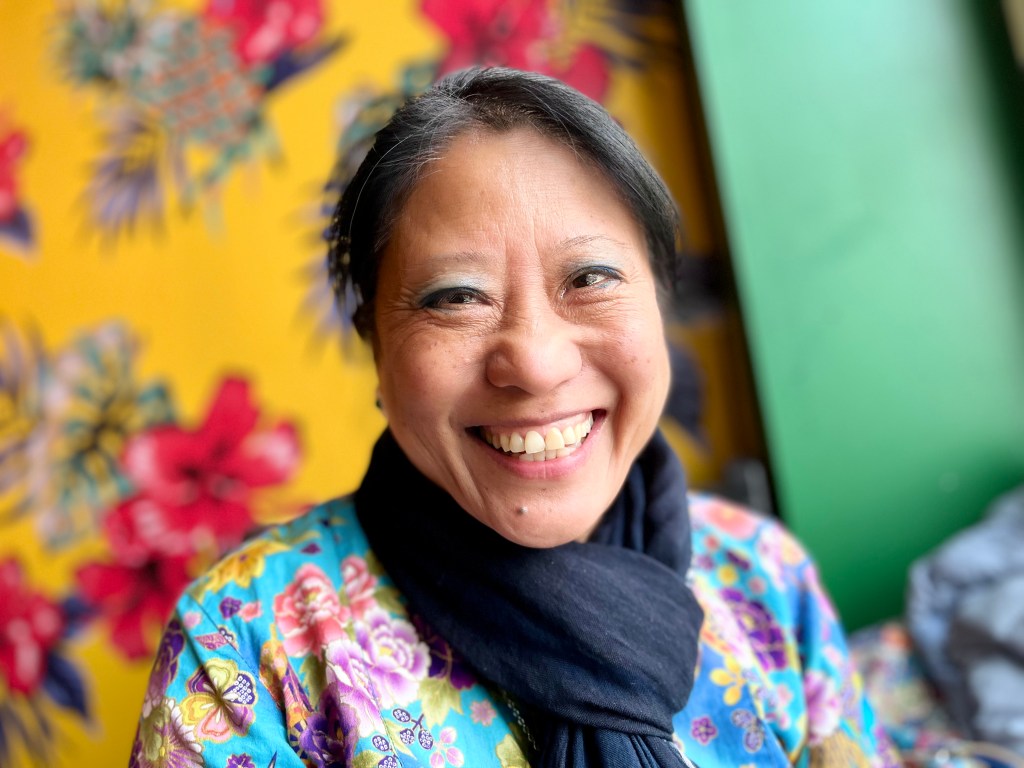
If I were to remember one face from the year 2022, it would be Rose’s face, her smooth brown skin, her blue eye shadow and red lipstick, her smile against the backdrop of the yellow wallpaper with pink flowers.
I hadn’t told Rose that 30th of September was my father’s birthday, as well as my Saint’s day. In the Ukrainian Orthodox tradition, four Saints are celebrated on this day, a mother and her three daughters:


 Small Rebellions