Tomorrow someone will inevitably ask me how my weekend was. It was ok, I will say, we stayed home.
At which point they will lose interest and leave alone, because it is a truth universally acknowledged that nothing interesting ever happens at home.
At home
Sunday starts with a rain so grey that we turn on the light. We make Sunday crêpes, as we do every Sunday, I call my parents, we play, we make lasagna. I usually hate to have people in the kitchen when I cook, but today I make an exception. I bask in their warm presence, in their delightful anticipation of our future meal. I even let them sprinkle cheese on top.
Then the sun comes out and children run off to see their friends up the street and I decide to go for a walk.
In the forest
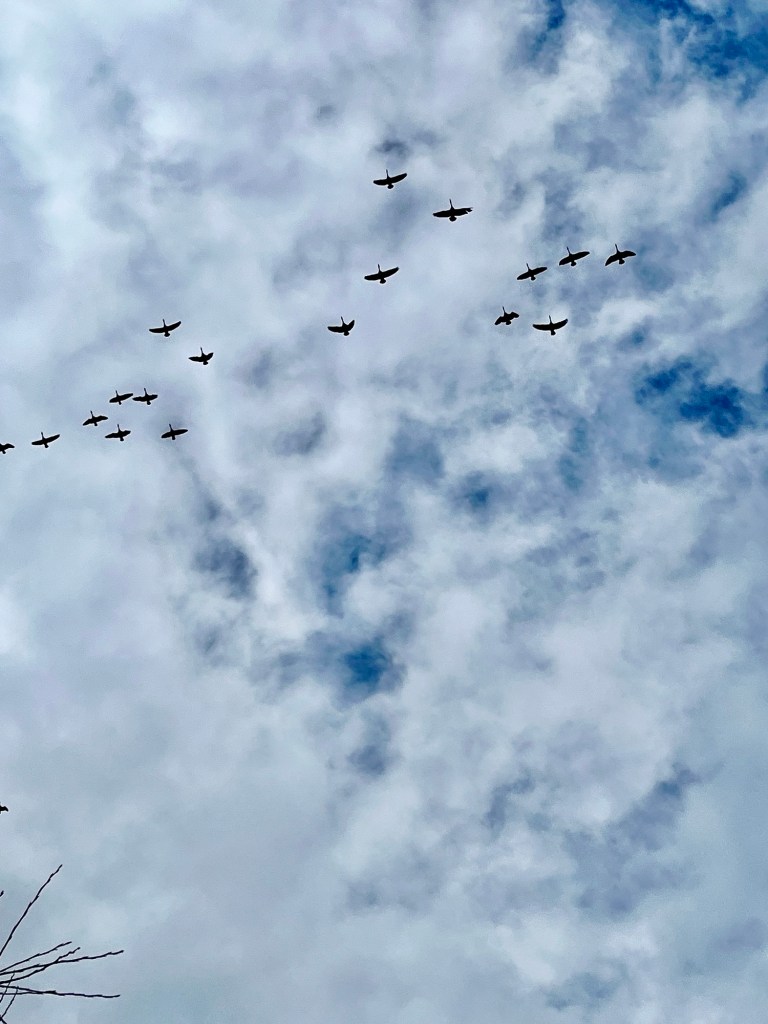
The geese are performing some kind of ballet or a musical: there are dozens of them up in the air, they circle, crisscross, change ranks, pair up. They accompany their aerial dance with long cries.
Not a single flower is out yet, but the mosses are luminous green, the fungi are sprouting from every tree stump and fallen log and the stones are painted green and silver with lichens. It’s amazing how once you know that everything alive, you start noticing that everything is alive, more than noticing – you start feeling it. And once you start feeling the life in everything, you start opening up to it, letting it pour into you. And you no longer look for a moment of breathtaking beauty, a catharsis, because you feel every moment. As Richard Wagamese said, The center of the universe is everywhere.
On my way home I notice some old trees, I assume maples, with wet patches on their bark. I touch one wet patch and lick my hand. It tastes sweet.
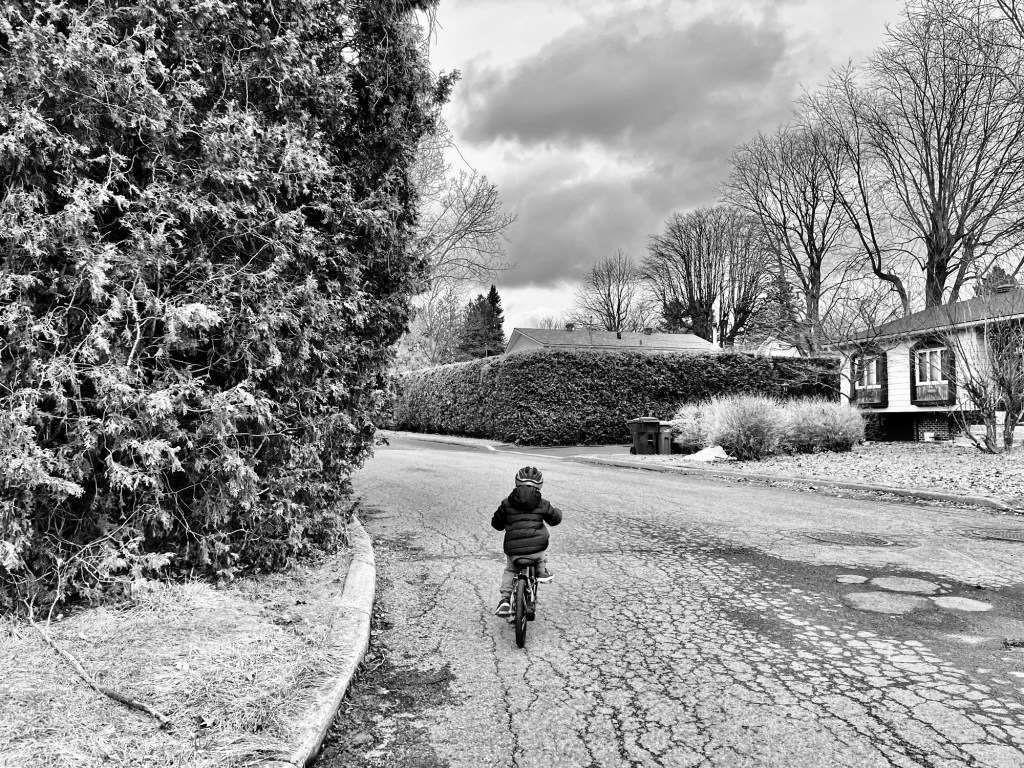
No petty sorrows of this week can compare with a sheer awe of feeling your child tear away from your supportive hand and seeing him pedal away. Of knowing that this is the first time, the first of many many many many many times. Ride on, baby! Mama is so proud.
Coming out of this long, painful, exhausting, humiliating and alienating week, I have realized something.
None of my ancestors have had a privilege of living in a world favourable to their thriving. Every single one of my female ancestors have at some point made the vow to survive.
My great-grandmother on my mother’s side must have made this vow when she was deported with her family, with her young children from her land all the way to the Far East of russia. She must have made this vow when her youngest daughter was born in that cold, foreign and unwelcoming land, where they lived in trenches and huts. She made this vow when they made their way back – two years of travel by foot, by train, by horse-pulled carriage back to the place of their ancestors.
My grandmother on my father’s side must have made this vow when she, the only child who survived the genocidal famine, moved from the village to the capital. She must have made this vow when she traded her dreams of being a singer for a low-skilled job that allowed her to feed her family.
My grandmother on my mother’s side must have made this vow when she was forcibly transported to the nazi germany to work on the rope factory, then on the farm as a de-facto slave. She must have made this vow when she raised her daughter (daughters?), while trying to shield him from their abusive alcoholic father.
My mother must have made this vow when she lost her mother at the age of 16 to cancer. She must have made this vow when she traded her dreams to go to university for a job that allowed her to feed herself. She must have made this vow when my father had his accident at the age of 37 and she had to scramble between low-paying, precarious and degrading jobs to keep me fed, clothed and at school.
None of my ancestors have had a privilege to realize their dreams. Their survival was their triumph.
I am the first of my family to have made it to university, to three universities, as if I had to do one for each of them. I am the first to be able to choose the career I want. I am the first to be able to move freely in the world, to go and to live in a different country without boundaries, limitations and humiliation. I am the first to have privilege to speak freely and without fear, even the first to speak the language I want. I AM my ancestors’ dream, the one they never even imagined possible. All their love, all their courage, all this survival in just one woman’s body.
I, too, may not have the luxury to live and grow in the systems that were made for my thriving. I may not always feel that I can breathe freely, that I can say what I want to say, to be understood, to be accepted unconditionally. But just like them, I make a vow to survive. I will survive for my ancestors, I will survive for my daughter, I will survive for my kin connected to me by choice if not by blood. I am living in the world that is reaping at all the seams, I am raising my children through the snowless winters and summers hot and pungent with wildfires, I am nurturing my friendship in the systems that punish authenticity. I am surviving. This is what women do, everywhere, all the time.
I will build the walls that I need to build to protect myself. I will only speak my truth to those who I can truly trust. I will divert my attention to the spaces and relationships that make me bloom. I will not offer more that I can give, will no longer rob myself of time, rest, joy and fulfilment to change the systems I cannot change. These systems are probably doomed, one way or another, and it is sad to think that we are probably doomed with them.
But for now, I will give my love and attention to the ones who need and deserve it: children, parents, gardens, ancestors, books, friends, birds, forest, strangers who are kin. I will detach myself things that hurt me: office politics, social media, being right, going an extra mile, bringing authenticity where it isn’t wanted. From now on I will put my survival first. Because my survival is not just mine, it is not selfish, it is tending to my ancestors dreams, it is giving my children the childhood they need, it is protecting my wild overgrown garden. My ancestors have survived and so will I.
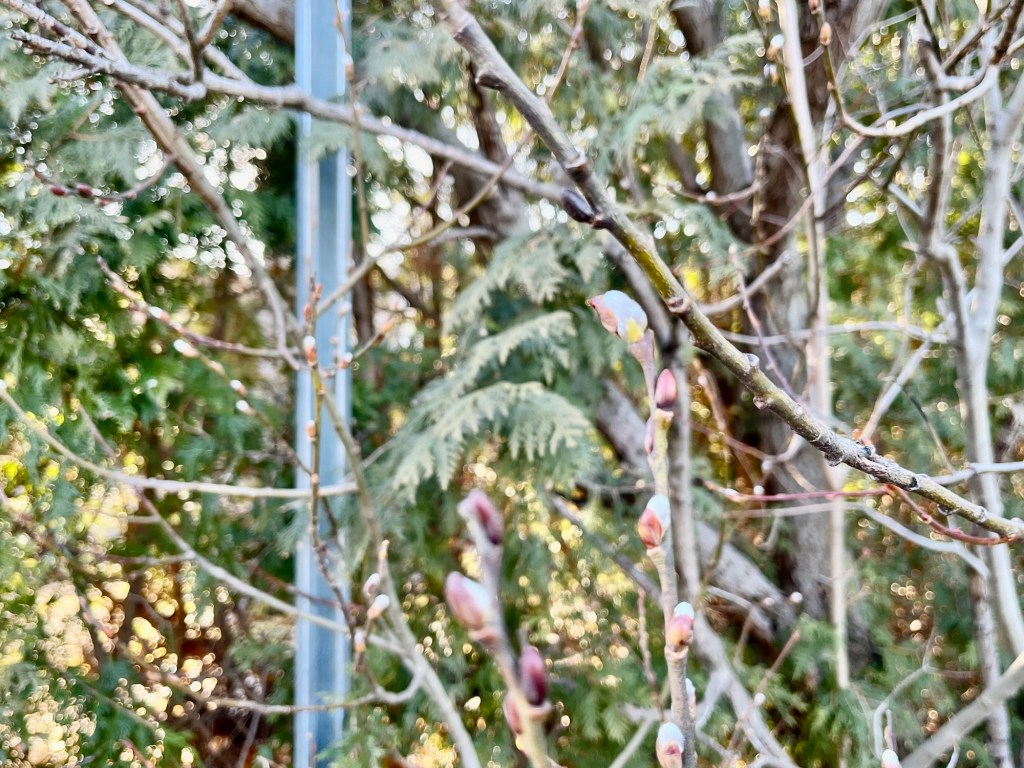
The willow is early to wake up this spring, too early, like everyone else, too eager, too quick. Still, every time I see its furry buds, it feels me with joy and Heimweh
This was a bad, hard, exhausting week, just like those weeks of past December. I thought the bad days were over, I thought I was over them – they returned with vengeance.
Nobody warned me that this spiritual awakening or whatever this is would be so painful. Except for, of course they did. Jonah and the whale, all those saints and Leonard Cohen. Anne Lamott: when everything is ugly it’s because something beautiful is being born. The birth is not beautiful in a politically correct sense – you did it twice, how come you don’t remember?
Remember, your son was born with his face turned up – a stargazer, they said. Apparently, it wasn’t “normal”. They were worried. They were about dozen in the room, while you were screaming with pain and effort, bloody, naked, vulnerable and fierce. They were worried, but weren’t showing it. They were professional, you – everything but. Then your son appeared, stubbornly staring up. He started screaming even before he was fully out and they disappeared. You didn’t see them leaving.
Birth is never beautiful, except it always is. You didn’t trust yourself then, you don’t now, you can trust the life force within you. Something is always being born.
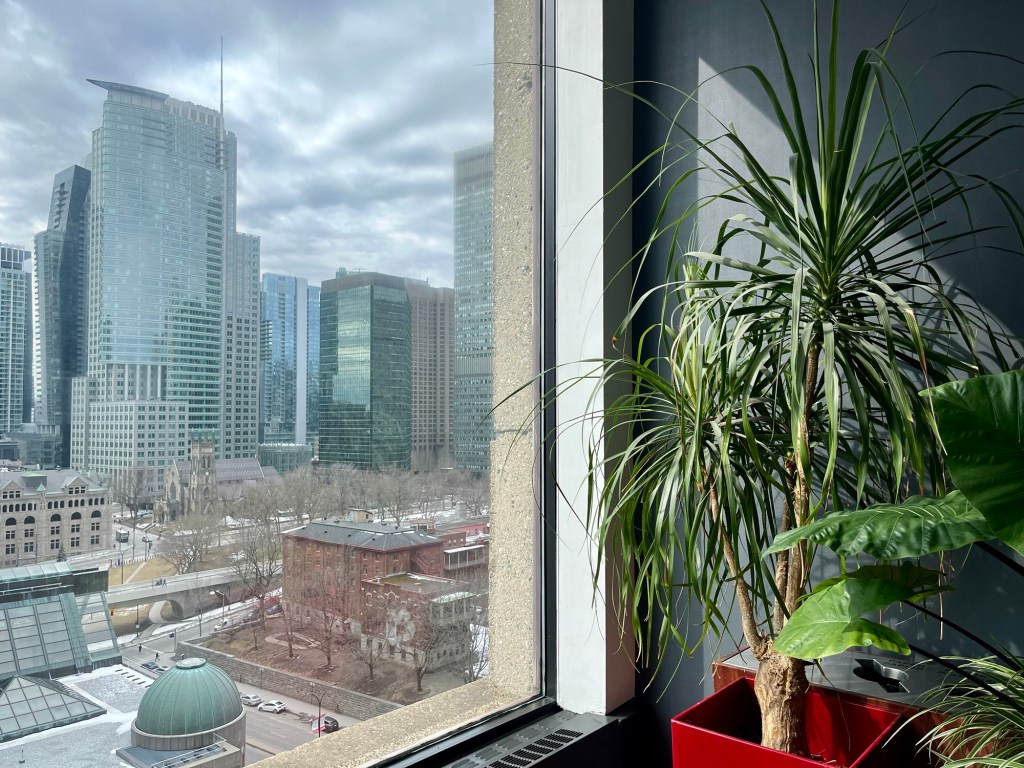
I am staring out of the window of the bus, trying connect the treads. The impossibility to keep on functioning in the corporate culture that divorces me from my humanity, that has no use for the best parts of me: passion, depth, creativity, joy and imagination. None of these belong in the grey office walls. They don’t match the carpet or the muted tones, the politically correct, the hushed, the dead end swallowing all change. I don’t match. I have to hush myself, but I don’t know how, I never knew. Both hushing myself and speaking my truth hurts. The culture I work in does not acknowledge the ebbs and flows of human psyche and I don’t know how to flatline.
The second thread: the necessity to find a spiritual practice. I am volatile and intense, impulsive and difficult, even with myself. Especially with myself. Back in the day when I was practicing, the practice grounded me. It didn’t save me from solitude or doubt, but it grounded me. It provided an infrastructure of love and discipline. I don’t think I could go back to my orthodox faith, even less to the Protestant one, but I need a practice.
I am staring at the landscape, disfigured by humans. Asphalted roads are snaking between rectangular boxes of identical stores. We’re passing a mall. The trees are few and isolated. They don’t look sick or sickly, just out of place. I can relate. I feel myself like a tree in an outdoor mall. I know that I belong. I am natural, rooted in the Earth, rooted in reciprocity, I feel my roots growing every day. But the landscape around me is bewildering. I am so separated from other trees, I barely see them. Instead, I am figuring out who I am in the midst of concrete and aluminium boxes, filled with fluorescent light and all kinds of stuff taken from the earth and transformed through the chain of human and other than human suffering into something unrecognised, unnecessary, totally superfluous.
Some days are such mixed bags of the good, the amazing, the annoying and sheer exhaustion. I’ve been thinking a lot about the loss of agency, especially in professional context. Where it hurts me the most is not being able to express my own ideas, to constantly rely on others to pass them on up the hierarchy ladder. And never hearing the feedback directly.
I am also thinking about losing (and regaining) spiritual agency. It brings me back to the history of prayer and my mixed heritage of orthodox and protestant faith that makes me wary of any kind of spirituality, but also draws me to it. I remember becoming a protestant a month before I turned fourteen. In the summer of the same year, or the year before – this is where my memory becomes blurry – my father had a accident that landed him in a wheelchair and stranded him for many years in Western Europe, without status and relying on support of the strangers. I remember praying for him, using an orthodox prayer scroll, so it must have been a year before my protestant conversion. I remember the desperate prayers of my youth – these were the prayers of someone who knew pain and injustice, who didn’t dare to hope that good things will happen in the future. I remember making a few halfhearted attempts to pray for my father to walk again, but I never had this kind of faith and I still don’t. I also remember that although I considered myself russian-speaking at the time, my first Bible was in Ukrainian, like a foreshadowing of things to come.comecome.come
Bearing the name that I have, I cannot walk away from faith, no more than I can walk away from my round Slavic cheeks and rolling accent. Faith is part of my heritage, passed down from my two grandmothers, both of whom had the name Vira. One Vira died before I was born, the other one had icons of Jesus and Virgin Mary in her home. She dreamt to be a professional singer when she was young (she had a marvellous voice that none of her children, grandchildren or great-grandchildren inherited), instead she worked at a grocery store. She raised three boys. She fed birds and stray cats, she had all kinds of plans, indoor and on her tiny datcha plot. I may have written about her already and I will do it again, because remembering her opens me up. Her name was Vira and she was always a believer in a quiet and unassuming way that is typical for most Ukrainian women.
The best thing about today was the abundance of stars I saw when I was walking back home from my dance class. And the dance class itself – it makes my otherwise painful Tuesdays tolerable. Today was one of the days that made me questioning whether I have a PTSD, am neurodivergent or slowly falling into depression. There is a happy, creative, functional, sensitive me at and around home and with people outside of my work, and there is me in the office – snappy, isolated, depressed, overwhelmed and discouraged. Twice already, I’ve been lulled by a promise that I would be able to change the workplace – to bring in my vision of equity, liberation and healing, the wisdom I have learned from others. Both times, I’ve been left collecting the broken pieces. The system wants the appearance of change, but resists change. Both times I have paid too high a price for too little a change. I am still paying with my mental and physical change.
So, now, having said that, let me formulate a wish: I want to heal, to really heal. To finally breathe without waiting when the next wave comes and brings me down. I want my next workplace to be truly liberatory. I want to be where I am wanted, where I can thrive, where I don’t constantly have to explain myself, to break down my thoughts and translate them into dead corporate language. I want to draw in colour and outside the lines. I want to be where words like magic and poetry and rewilding and rest truly mean something.
In my multicultural family, I am the only person able to speak multiple languages. Every member of my family inhabits a particular culture and language – their own comfort zone. This leaves me as the only person who navigates between other’s people’s cultural and linguistic comfort zones – changing language to suit their preference, looking for relevant cultural references, constantly translating and explaining. The rare holidays with my mother, my husband and kids are lovely, but I am always given the role of the translator – not only from language to language, but between the habits, expectations and preferences. It is exhausting, especially for an introvert who just wants to be left alone with her thoughts, preferably somewhere on a mountain with a view.
I feel the same exhaustion at work. I feel like I am constantly translating. Not only from English to French, but from the language of the heart, creativity and spontaneity to the one of Excels, hierarchies and corporate BS. And what’s worse, I have to translate back. I should never lead people on, let them believe that I represent an organization for which I work, because I do not. I am an outlier, a deviant. If I were to give some fantastic beast avatar to myself, I wouldn’t be a unicorn – I’d be a dragon.
Ramadan gift my daughter got from a classmate. May this blessed month bring peace to all who need it.
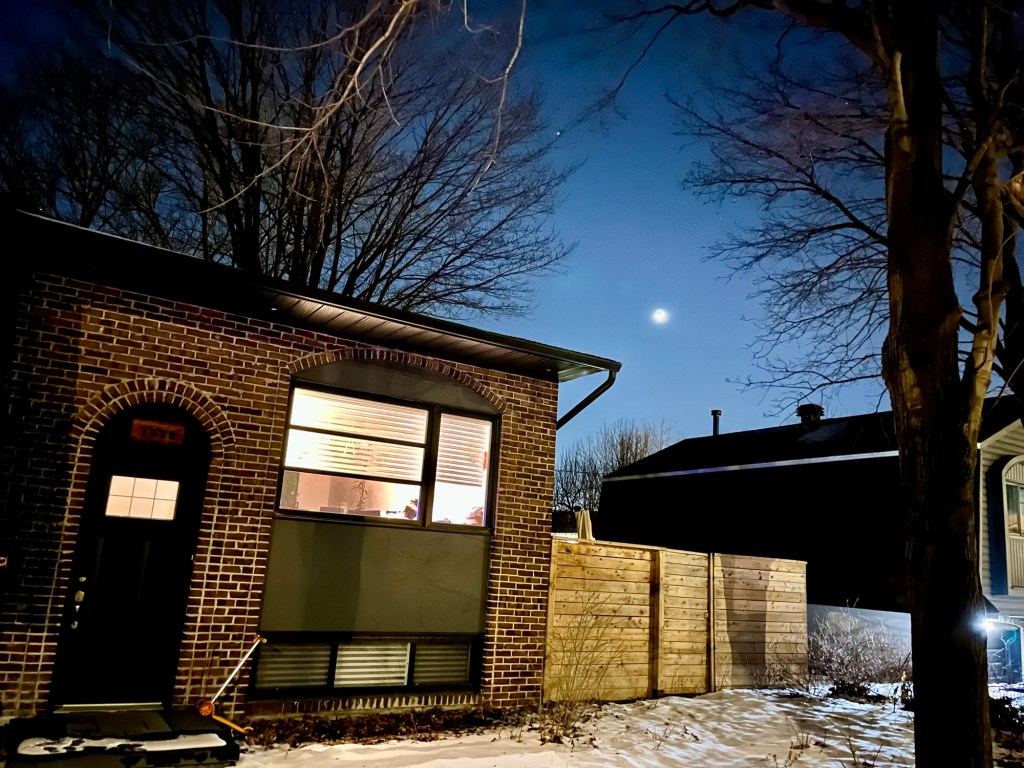
The snow is back. Heavy, waterlogged March snow. It will probably be gone by Wednesday or Thursday, but for now the world looks almost normal outside of my window. The world outside of my window is a couple of maple trees, squirrels running up and down the trunks, a small suburban house, almost a mirror reflection of my own, another tree of some unknown to me species with a bird-feeder. It used to attract all kinds of birds, now I hardly see any. Maybe, the winter was too warm, or maybe the neighbour stopped filling it.
We switched to the summer time this weekend. Now once again I wake up in heavy darkness. In the evening when we come back home though it is still full light. I feel lost and disoriented, as if something sad happened, but no one wants to tell me what.
Mstyslav Chernov got an Oscar for the best documentary for 20 Days in Mariupol. I went to YouTube to watch the trailer (which I’d already seen). The trailer is 1 minute 49 seconds long. I broke down and started sobbing uncontrollably 30 seconds in. For the rest of the day, I am trying not to think about it.
It was the adjectives that first tipped me off. I like adjectives, in moderation. I like them in a Charlotte Bronté novel. It was a dark gloomy morning, reader. This kind of thing. I hate adjectives in news articles and social media posts. I hate them even more than hashtags. When every name or noun in a news article gets its own adjective, you know you’re reading propaganda. Propaganda, written by good guys, is still propaganda. It is inherently untrustworthy, even if written “by us” and “against them.” The more you read propaganda, the longer the string of adjectives gets, the wider the divide between us and them becomes and the more intense the pressure to prove that you are “us.”
I understand how people get high on solidarity and the feeling of being right. But, coming where I came from, this is when I defect. This is what I love about Ukrainians. We always remain sceptical, especially of power. We know that every revolution has a potential to become a reign of terror. It doesn’t stop us from doing revolutions, but we don’t descend into tyranny. From what I know of Ukrainian history, we never had a home-grown tyrant.
Here is a funny story: I must have been nine when I got recruited into a school choir. Together with everyone. There must have been about ninety or a hundred children my age in that school and we were all in the choir. The ones who could sing were put in front, I was in the fourth row, which was the last. There is a theory, proven by practice, that in a large enough group even people who can’t hold a note eventually fall in tune. I suspect that I may be an exception to this rule, because I was the only child who was kicked out of the choir. Even all the way in the back, I managed to sing out-of-tune enough and loud enough to make other kids lose their tune.
The social media feed becomes more and more like the Hate Week in Orwell’s 1984. There is no more nuance, there is no more conversation. Instead, we are shouting slogans at each other. The ones who today are praised because they speak of justice are the same ones who yesterday advocated for violence. They say that none of us are free until we all are free. In reality, “we all” most often means “all of us, but not them.” The question is, who decides who “they” are.
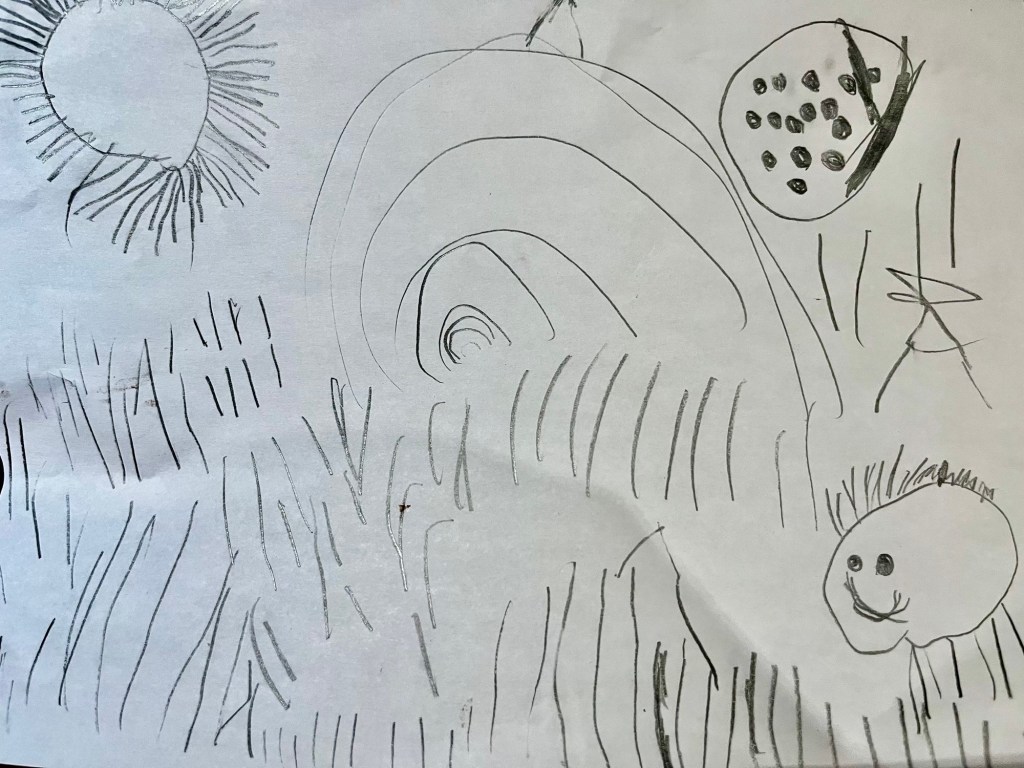
Another masterpiece from Julien. On this intense landscape one can observe the sun, the moon, a rainbow, rain, grass and a very serene hedgehog with seven legs (no, it is not a spider).
This March 8th it feels like most posts on my social media feed are subtly or not so subtly accusing others of not being good feminists. The feed, usually passive agressive, is now bristling with outward hostility. I gave up writing anything publicly and should give up reading, but part of me is addicted to the toxic air and wants to know what happens next.
Growing up, March 8th was a big deal. It replaced Mother’s day, St. Valentine’s and all Spring holidays altogether. Officially, it was Women’s Rights Day, unofficially, it was the Day of the Woman, the Day of Beauty and Spring, sometimes even the Day of Love. Everything, everywhere, all at once.
In kindergarden, March 8th was celebrated with a talent pageant where neatly dressed children were reciting badly written poems about how they love their mothers. Because there was no mothers’ day, March 8 served as a proxy. When I think about kindergarden days, I usually remember exceptionally bad food and lack of water (for some reason, we were not allowed to drink between meals). Today, however, I wondered about the amount of poetry I had to memorize as a child. I suspect that poetry was a soviet fetish. My own children, growing up in Canada, never learned a single poem. I knew tons. We had to learn poems in kindergarden and recite them in front of our parents, we learned poems throughout school, and even at home, I was constantly asked to recite poetry to friends and relatives whenever they gathered. Reciting poems in front of adults was an ultimate soviet childhood experience. I wonder if anyone wrote books about it, if anyone ever wondered why we were forced to learn so much poetry by heart.
In school, March 8th became more nuanced. There were still some remains of Mother’s Day that gradually were being replaced by the complex politics of reciprocity. See, the International Women’s Day had its male counterpart. Men and boys were celebrated on February 23 – the Day of the Soviet Army. Which was ironic for many reasons: first, celebration of the military as all things masculine; second, celebration of all men as warriors in the country, where about half of the menfolk were dodging military conscription and for a very good reason. Still, the rule remained: on February 23 the girls were giving presents to the boys to have the favour returned two weeks later. The popular joke went: how you spend your March 8 will depend on what you did on February 23.
When I got to the end of the high school and into the university, the Soviet Union was long gone and March 8th was gone with it, at least for a while. Some flower giving and cheesy postcards remained as a silly habit that one can’t quite shake off, but the rest was gone. I never missed it.