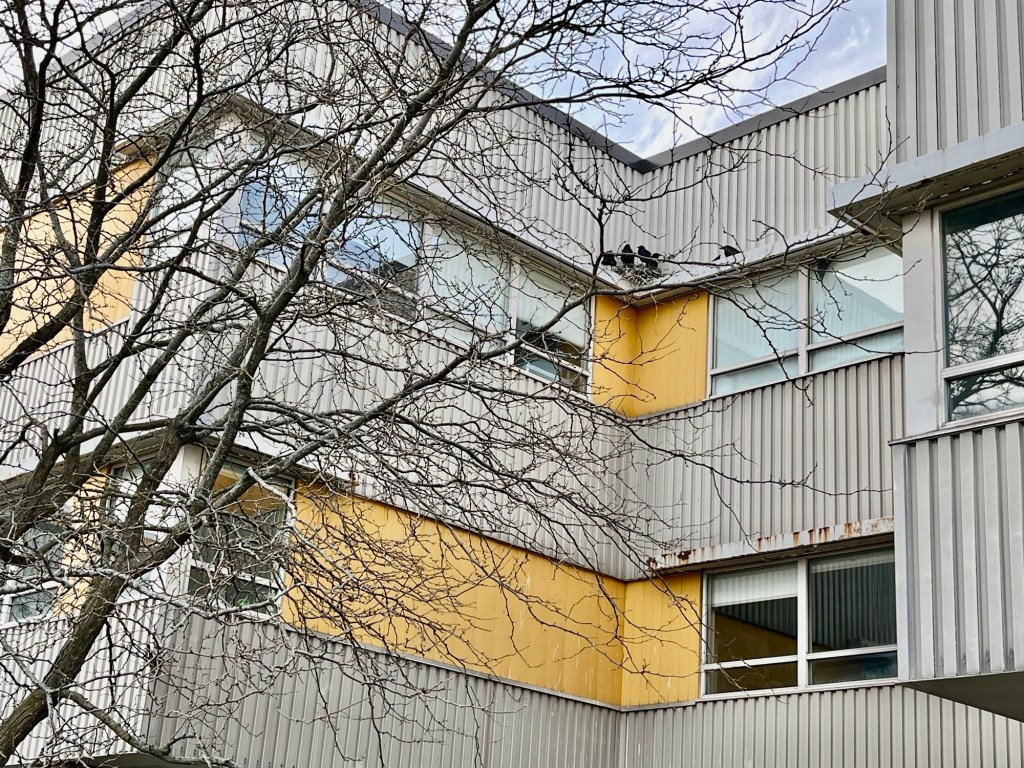
The raven nest we noticed in the corner of the very ugly building of our local high school. There are always five or six ravens in and around the nest and it looks like they’re having a very busy family life.
The raven nest we noticed in the corner of the very ugly building of our local high school. There are always five or six ravens in and around the nest and it looks like they’re having a very busy family life.

What sustains me through these days and weeks and wandering, trying to figure out who I am and who I want to be next, with whom and how, are connections. My connections to other people and my connections to the living world. I’ve learned how to be with people without expecting anything beyond what we can give each other here and now. It’s the same as being with the world. The forest does not expect anything from me, neither do the birds, the orange sunsets or the silky young leaves. I witness their awakening and, in their own way, they witness mine. We are enough for each other. I am learning to do the same with people over cups of coffee and conversations over zoom. Just be there, be with, the rest will figure itself out, as it always does.
I am so tired, but I feel nothing but love. I fell held and surrounded by my communities. I’ve always marvelled at people who spent all their lives in the same place, who still had their childhood friends. I always wondered what it would feel like to be so connected, rooted and known. But it will never be me. Instead, I have many foster communities. I may not be native there, but I am still welcome and this too is enough.
I’ve spent most of the week in a sleepy and apathetic state. There is a lot of frustration and latent tension at work, mainly between MA and myself. I am certain that it is on both sides. The more she’s frustrated, the more she pushes into the safe, mechanical and productive and the more I resist. The call of the deep and the wild has never been so irresistible as when something keeps me from it.
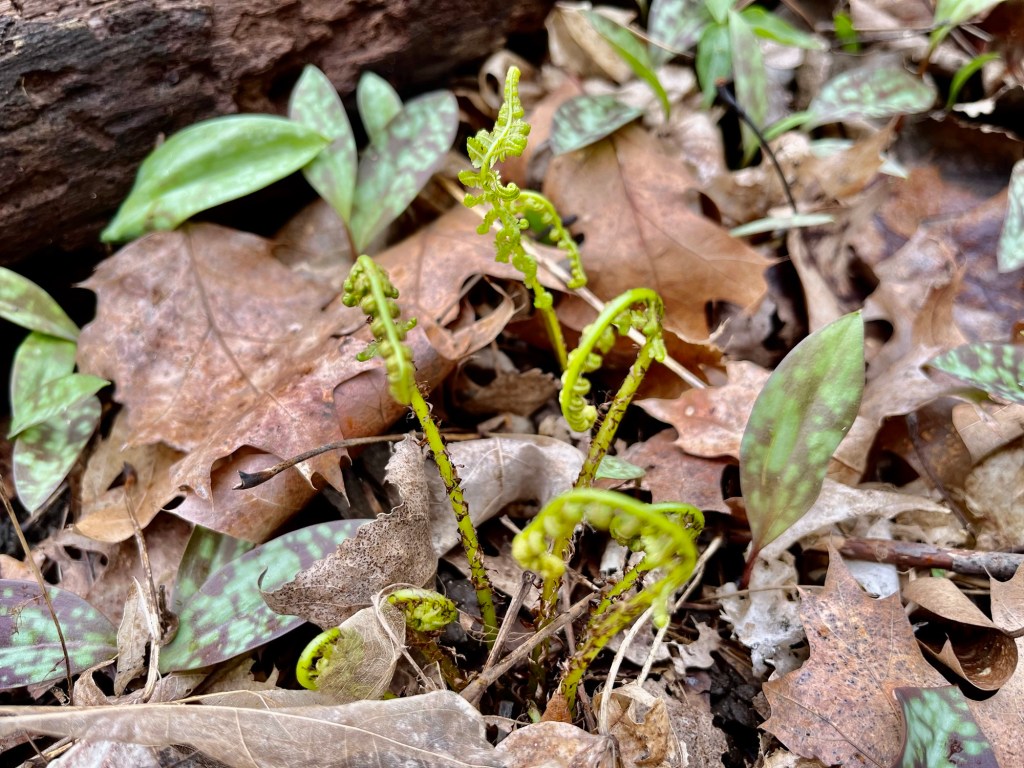
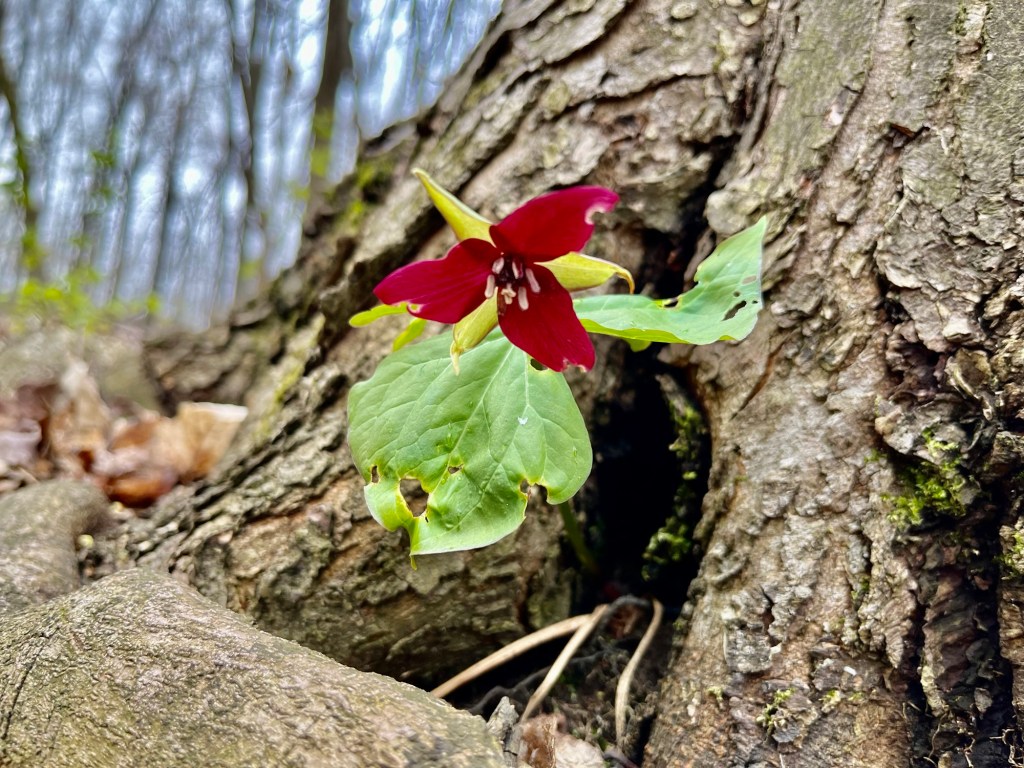
Forest is definitely medicine. As soon as I am in proximity of it, I exhale my frustrations, get out of my head and into my body. I am here, I am alive, I am paying attention. So many things are happening at once, but their unfolding is soft and never brutal, it surprises me without overwhelming. The trees are now surrounded by the pale green halos of new leaves. The browns on the last year’s leaves soften. They look like a cradle for the young ferns. I saw the red trilliums I’ve been looking for as I was leaving the forest.
But the most beautiful and unexpected gifts was the song of a white-throated sparrow. Now that I am used to the cardinals and robins, that sparrow totally caught me off guard. The most beautiful song I’d heard. I played it to my daughter in the evening. She said it was si-si-sol.
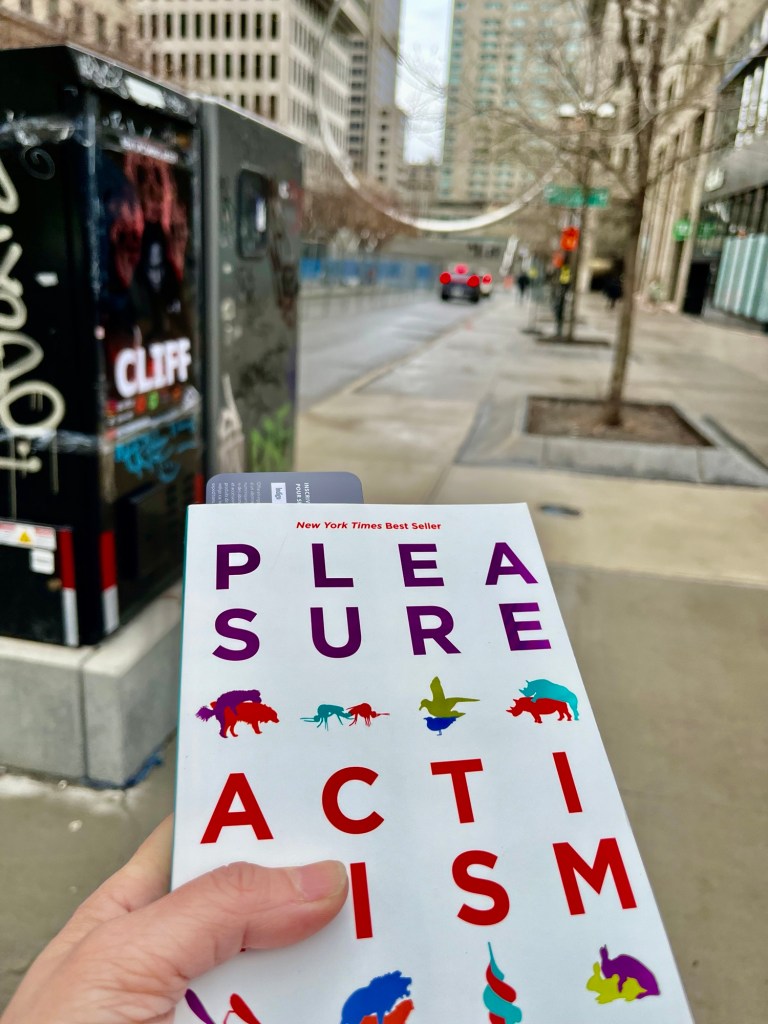
It was raining all day – cold, grey, unpleasant rain and the day was just as bleak as the weather. I went to a bookshop to look for a gift for a child’s birthday and instead bought a book for myself. It felt like the right moment. It felt like long time coming.
I am following interconnected threads: the realisation that although I have left evangelical movement long time ago, I have never managed to shed off the evangelical lens. I keep approaching such fundamental themes as spirituality, body, sex, relationships from that narrow and binary point of view. For example, I have never read the Bible without considering it to be God’s word. I have always seen my body and my sexuality through the lens of the purity culture. Even worse, I see my body and my sexuality through the double lens of purity culture and body shaming. My friends and I were in our late twenties when we started breaking free from evangelicalism and experimenting with dating, relationships and sex. Yet, now I realize that we weren’t really free: even in our own eyes, we were not just experimenting, we were sinning.
In my late twenties, I was extremely inexperienced, even dim in everything that concerned sex, sexuality, sexual orientation and relationships. What’s worse, I couldn’t share this fact with anybody or seek guidance, because I was ashamed of my own naïveté – I was a decade too late. I realize now that all my early (in terms of experience, not age) sexual experiences were non-consensual and violated my boundaries. I have never had a chance to experience, explore, to ask myself what I like or to even admit the existence of my sensual side. I have definitely never had a chance to connect my sensuality to the other parts of my personality: my fierce intellect, my insatiable desire to learn, my love of hard work, my ambitions. It was last year during the Spring Café at the Edge of the World that the disconnect became impossible to ignore: I was stimulated intellectually, but when we were asked to engage in any kind of bodily experience I froze in fear. Dancing, grimacing, wearing accessories, putting on lipstick – everything felt terrifying. It is through unraveling the threads of possible religious and sexual trauma that I came to this point: I need to be able to face and understand the past and through this I need to create a possibility of a liberated future for myself.
I need therapy. Somatic therapy seems like a good choice, although I don’t fully understand what it means.
I need to shift the narrative about desire, sex, sensuality and purpose to the point when it’s no longer dominated by shame and puritanism.
I want to try something: for the next several weeks, at least, I will be asking myself: what brings me joy, what brings me pleasure and what I desire.
I will remember that just because things are the way they are now, they don’t have to stay this way. Other ways are possible.

Mondays are struggle, but Monday evenings are wonderful. Especially this Monday evening, because it comes with no obligations, no Damocles sword hanging over my head. No overtime work, no schoolwork, no tax declarations, no preparation for board elections. This Monday evening is wholesome: a run outside, a new book, a glass of wine, no regrets, no scratching old scabs, no soul searching, not tonight. Tonight is adrenaline free, just rest. I’ll think about everything else tomorrow.
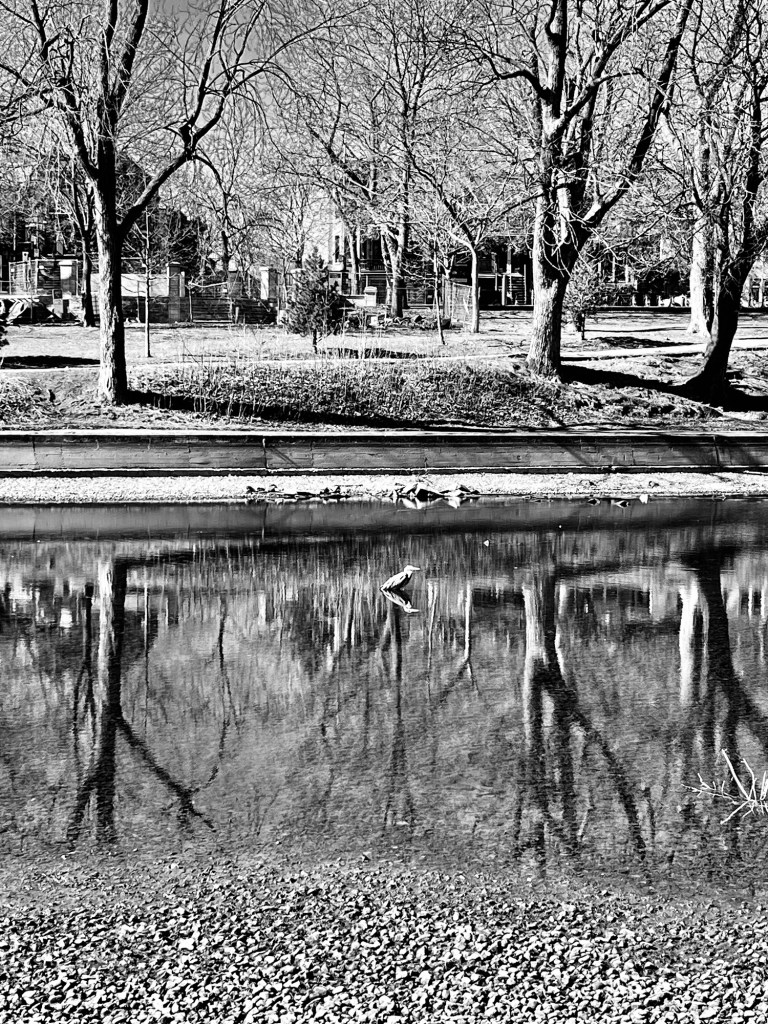
My fast and furious week is thankfully coming to an end. I went for my first run of the year on MountBruno.
I read the Exvangelicals by Sarah McCummon. Reading this book for me is like peeling and scratching the scabs on a deep wound. It feels almost cathartic to read all those names that defined my adolescence and deluded me for so long, hearing them to be called out for who they are: Josh McDowell, Tim LaHaye, Joshua Harriss, The 700 Club, Superbook, creationist workshops, campus crusades. At some point, Sarah discusses how some of her exvangelical friends feel that they’ve been held back by decades because of their church upbringing. This is exactly how I’ve felt for years. I feel that I lost those 10+ years, that I was robbed of a chance to build friendships without the pressure of prozelitizing, to engage in intellectual life without the narrow and bigoted evangelical lens, to learn about relationships and sex without shame (your fault, Joshua Harriss!) Yes, evangelical movement gave me support after my father’s accident, it gave me friends and some truly exhilarating experiences, but mainly it has robbed me of an opportunity to explore, engage with the world to freely choose who I want to be and how. This is not something I will ever get back, but at least now I can face my trauma and hopefully one day heal.
Someone in the almost-empty bus must have been peeling oranges for breakfast, now I am floating in the tangy, citrusy smell. I am deeply grateful to this stranger for an unexpected olfactory treat. Also, thinking of maybe adding oranges to the grocery list.
I’m thinking about the recent flare-up of my impostor syndrome, how it came up on a week choke-full of events, complete with getting elected to a board and sending in my last assignment for the intercultural leadership course. How although everything feels like too much, I never feel like enough.
I am thinking about my generation. Not all of it, my generation of Ukrainians, specifically. When I entered the university, independent Ukraine was only five years old. I’m thinking of what it meant for a nation to become a country for the first time in its history and how many hopes were placed on us – the first generation that came of age in the independent country. I was among the first who obtained higher education in Ukrainian. We didn’t have textbooks yet and we refused to use the old Soviet textbooks printed in Russian and choke-full of communist propaganda. We had a student government. I was part of it, although I did not understand the significance at the moment. We felt free. We felt special.
I believe that my imposter syndrome has a lot to do with this expansive, overwhelming promise of my youth. With the time when we wanted to forget the past and erase the trauma and start from the blank page. Of course, the page was not blank, but we managed. We wrote something new and different on it. My imposter syndrome flares up to ask me if I’ve lived up to this promise. You could have been so much more, it says. I was never taught to be who I am, only to be more, always more. Maybe, that’s the problem.
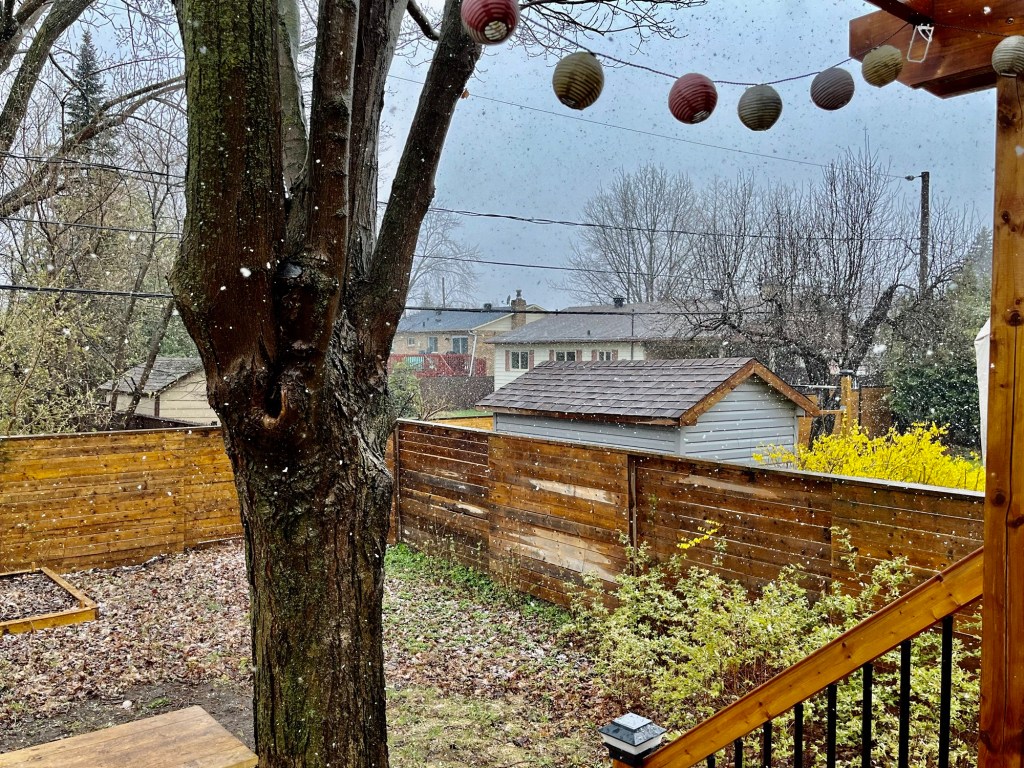
We had snow today. Over a few hours, the temperature dropped from 15 to 2 degrees and rain turned into snow. Then, like this, it stopped.
I slept badly and woke up tired. My brain went again into frenzied overwhelm, dreaming of meetings, people, events, not wanting to let go. Being deprived of exercise for two days doesn’t help. Being in the city and in front of the screen too much doesn’t help either. I need trees, birds and a lot of movement to heal.
The theme of letting go keeps showing up for me in major way. First, it appeared in Sanctuary Sangha, in my conversation with Nicole and Stephanie. To the question what practices I need to prepare the ground for my work, I instinctively replied letting go. It reappeared yesterday in conversation with Bina: what do we need to let go of to do our work? Finally, I just thought about it today. I need to let go. Of projects, hustle, nervous excitement, exaggerated expectations, ego. Say it again, letting go of ego. I wonder if there is a going to bed ritual for that.
Also, quite unexpectedly, I was elected on the board of COCo. And Griffin wrote. They said, if you have time in the next few weeks to connect. To which I immediately thought, I’m so busy in the next few weeks. And the second, wiser thought: that’s why I need to slow down. Maybe, I’m becoming someone I can finally live with. Cheers to that.
My son thinks that babies can’t die, because they are little. I’d give anything to make that true.
It’s full moon. I am tired, or rather tethering between deep underlying exhaustion and bursts of creative and communicative energy, by which I mean the times when I actually reply to people’s emails. also, I missed my dance class today and feel this temporary loss.
I am in this strange space when I am doubting and second-guessing everything I say or do. Like being in a space with many amazing and creative people who care about anti-oppression and feel like I don’t belong there. No, worse, like no one wants me there, although everyone showed me nothing by kindness. I’ve met hundreds of new people over past year, yet something in me still can’t believe that people may be genuinely interested in me or seek out my company. I need to understand why and how this imposter syndrome flares up.
The day is sunny, but cold because of an icy wind. Still, we walk to and from school and I try to go outside every minute free of meetings.
I feel tired and unwilling to move, think or talk for most of the day. However, it’s the day of the kickoff of the grantee cohort and I have to be present. Turns out, being tired and out of sorts doesn’t stop me from holding space for others. Maybe, because in this diminished state I take up less space myself. Feeling less energy, I don’t fidget or show my impatience, I don’t get upset when conversation goes overtime or when we miss things on the agenda, I don’t overanalyse. I’m just happy to do the best I could and decide that this is enough.
Strangely, everyone loves the meeting and my teammates comment on how seen and liberated they felt. The day left a good taste in my mouth. I felt tired and lowkey, but not exhausted. I felt enough. Or maybe I felt ok with not being enough. Maybe, as it often happens, the signal I’ve sent to the universe is resonating back to me. I said that I wanted to learn to let go and lo and behold, I am learning.
Thank you

